

X3Y2(SiO4)3
Ancient fire rising through the voice of truth
The name garnet traces to the Latin granatum — the pomegranate — and specifically to its seeds: the deep-red, jewel-bright arils that small almandine crystals uncannily resemble. The word passed through Old French grenat and medieval English before settling into the form used today. Each of the eight members of the group carries its own distinct naming lineage:
Almandine takes its name from Alabanda, an ancient city in the Caria region of present-day Turkey, where the deep-red stones were traded and cut in antiquity. Andradite honours the Brazilian statesman, geologist, and mineralogist José Bonifácio de Andrada e Silva (1763–1838). Goldmanite is named for Marcus I. Goldman (1881–1965), a geologist with the United States Geological Survey who worked extensively on the sedimentary sequences of the American Southwest. Grossular derives from the Latin grossularia — gooseberry — a reference to the pale green of certain varieties that bear a striking resemblance to the unripe fruit. Pyrope comes from the Greek pyropos, meaning "fire-eyed," for its intense, almost luminous red. Spessartine is named after the Spessart forest district of Bavaria, Germany, where the orange-red variety was first documented. Tsavorite takes its name from Tsavo National Park on the Kenya–Tanzania border, near the site of the gem-quality deposit's 1967 discovery. Uvarovite honours Count Sergei Semyonovich Uvarov (1786–1855), Russian statesman, amateur mineralogist, and president of the Imperial St. Petersburg Academy of Sciences.
All garnets share a single structural blueprint: isolated SiO4 tetrahedra — qualifying the entire group as nesosilicates — held in place by two distinct cation sites. The X site, 8-coordinated and dodecahedral in geometry, accepts divalent cations such as calcium, magnesium, iron²⁺, and manganese. The Y site, 6-coordinated and octahedral, holds trivalent cations including aluminium, iron³⁺, chromium, and vanadium. The cubic crystal system (space group Ia3̄d) is invariant across every member: all garnets crystallise in the same symmetry and form the same characteristic 12-faced rhombic dodecahedra or 24-faced trapezohedra, regardless of chemical composition.
The group divides naturally into two solid-solution series. The pyralspite series — Pyrope, Almandine, Spessartine — shares aluminium on the Y site while the divalent cation at X varies (Mg, Fe²⁺, Mn). The ugrandite series — Uvarovite, Grossular, Andradite — shares calcium at X while the trivalent Y cation varies (Cr, Al, Fe³⁺). Most natural specimens are intermediate compositions rather than pure end-members. Goldmanite sits within the ugrandite series with vanadium filling the Y site — an arrangement that gives it both its intense green colour and its considerable energetic density.
Garnet is among the oldest minerals in human use. Archaeological evidence places it in Egyptian jewellery as early as 3100 BCE, and Bronze Age burials across Europe have yielded garnet beads and inlays. Ancient Romans favoured it for engraved intaglio ring stones, and the deep-red almandine — often called carbuncle — was among the most prized gems of the medieval world. For centuries, the Bohemian pyrope mines of what is now the Czech Republic were Europe's dominant source of red gemstones, supplying courts and jewellery workshops with what was marketed as "Bohemian ruby." The stones were mined by hand from weathered serpentinite gravels, cut in cottage workshops, and exported across the continent.
The 19th century brought rigorous chemical classification and the formal identification of the individual species. Grossular was described in 1803, uvarovite in 1832, andradite in 1868. Goldmanite — the youngest full species in the group — was not formally described until 1961, when it was identified from Coyote Peak in Colfax County, New Mexico, USA, occurring in vanadium-bearing carbonatised ultramafic sills. Tsavorite was discovered in 1967 by British gemologist Campbell Bridges in the Lelatema Mountains of Tanzania near the Kenyan border, within a metamorphic belt of Neoproterozoic gneisses and schists; Bridges later developed the deposit on the Kenyan side, and tsavorite remains one of the most recent additions to the canon of major coloured gemstones.
Today garnet is produced on every inhabited continent. Tanzania's Umba Valley and Tunduru fields yield colour-change varieties. Russia's Ural Mountains and Namibia's Erongo region are the primary sources of gem-quality demantoid andradite. The Merelani Hills of Tanzania produce tsavorite alongside tanzanite. India, Sri Lanka, and Madagascar are major sources of almandine and spessartine, while uvarovite comes principally from the Ural Mountains of Russia and from Finland.

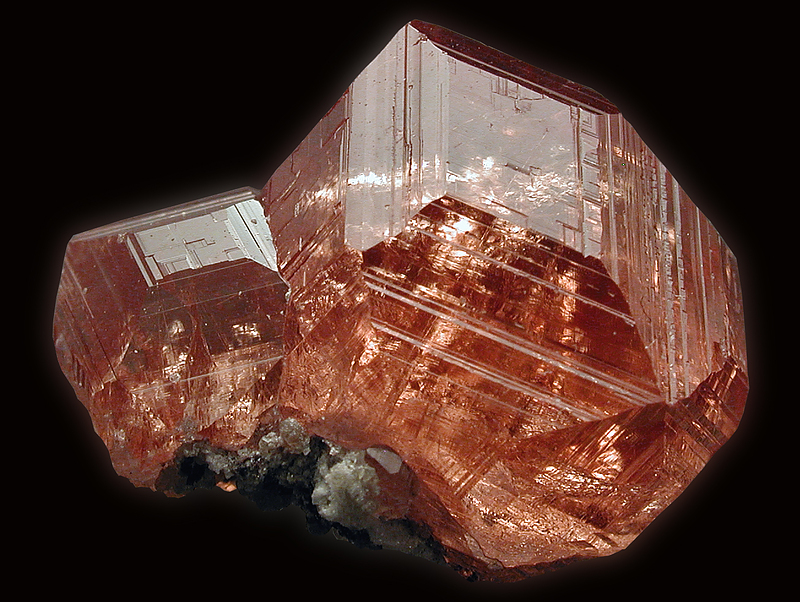


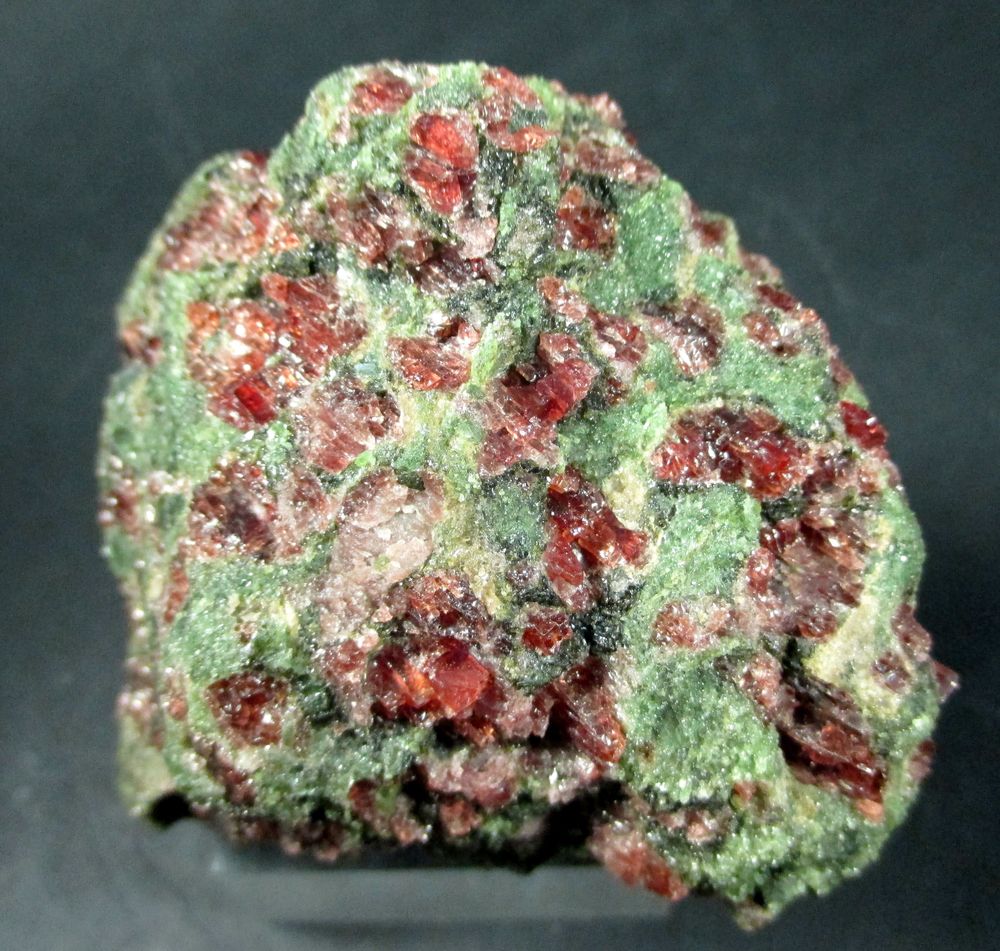

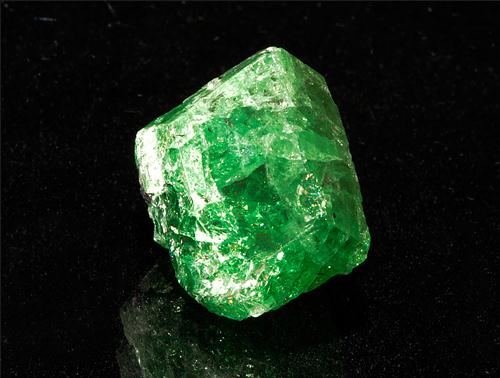
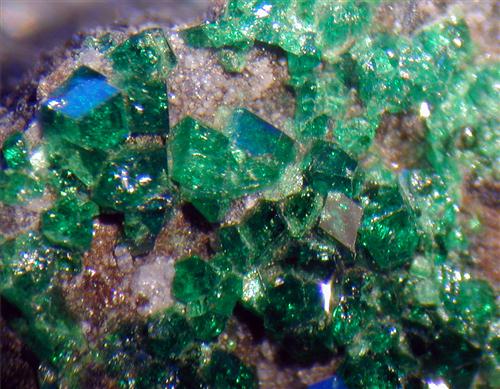
The X₃Y₂(SiO₄)₃ framework is one of nature's most chemically accommodating mineral structures. By varying only two cation sites, it produces eight distinct species and dozens of intermediate solid solutions — a chemical range unmatched among major silicate groups that share a single unvarying crystal architecture. No other common silicate mineral group spans the same structural uniformity (identical symmetry, identical habit, identical space group) across such a sweep of different chemistries and colours. The garnet architecture is, in this sense, nature's most versatile mineral blueprint.
Uniquely among the major silicate gemstone families, the garnet group spans every colour of the visible spectrum within a single mineral group — from colourless through yellow, orange, red, purple, green, black, and even colour-change blue-to-purple. Each hue arises from a specific transition-metal ion occupying the crystal framework: iron²⁺ produces red and brown (almandine); manganese generates orange (spessartine); chromium yields vivid emerald green (uvarovite); vanadium creates blue-green tones (goldmanite, colour-change varieties); and iron³⁺ in the andradite structure produces dense black (melanite). The garnet framework accommodates this full chromatic range without altering its geometry by a single bond angle.
Garnets rank among the highest refractive-index minerals in the common silicate world, with values ranging from approximately 1.72 (pyrope) to 1.89 (andradite) — far above quartz (1.54) and approaching the domain of dense oxides and sulphides. This optical density means that light entering the crystal bends sharply, reflects internally, and exits with an inherent brilliance and surface lustre — sometimes approaching adamantine — that requires no special cutting geometry to achieve. Combined with the cubic crystal system's lack of birefringence (no double refraction, no blurring of light paths), this gives even unpolished garnet crystals a luminous depth in good light that few silicates can approach.
"The devotee of God wants to eat sugar, and not become sugar."— Ramakrishna
Garnet has kept company with human beings since before there were cities, and the reason is in the hand the moment you hold one: it carries the body's own banked fire. Its deep red is the primal current at the base of the spine — the kundalini that, drawn upward through the sushumna, becomes the slow burn that clears a person from the inside out. Though its note sounds at the throat, its real work is down at that root, and the love woven through it keeps the fire in the circuit of the heart, so it warms rather than scorches.
This is vitality itself, the river that feeds the whole system, and garnet does not flare and fade — it is a steady, long companion that keeps tending the fire for as long as you carry it, and the aliveness it grounds into the body has a clear, thoughtless gladness to it. Among its kin, goldmanite stands apart: it opens the heart and, in the same motion, anchors that opening down into the earth, so love arrives as weight and presence rather than drifting off into abstraction — with szenicsite and bayldonite carrying the same signature more lightly, a gentler way in for anyone not yet ready to be met so directly.
"You will get into samadhi if you gradually keep increasing the duration of meditation."— Shivabalayogi