

PbS
The deep grey anchor of the root
Galena takes its name from the Latin galena, a word used by Pliny the Elder for lead ore and for the dross left when lead is smelted. The name has come down almost unchanged for two thousand years, marking it as one of the oldest known and most worked of all minerals.
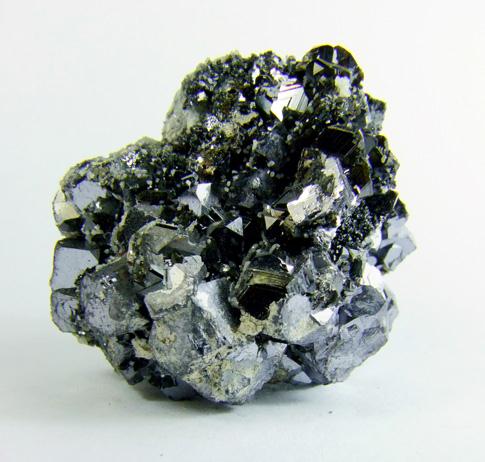
Galena is lead sulfide, PbS, isometric in symmetry and famous for its near-perfect cubic crystals and cleavage — break it and it splits cleanly into little cubes. It is lead-grey with a bright metallic lustre, soft (about 2.5), and remarkably heavy for its size, one of the densest of common minerals.
It is by far the most important ore of lead and a major source of silver, which it often carries hidden within. It forms in hydrothermal veins and in sediment-hosted deposits, usually alongside sphalerite, the principal zinc ore.
Galena has been mined since antiquity — for lead, for the silver it hides, and even, ground to powder, as the dark kohl eye-paint of ancient Egypt. It is found worldwide in lead-zinc veins and bedded deposits, from the great districts of Europe to the American Midwest.
In the early twentieth century its natural semiconducting surface made it the heart of the “cat's-whisker” crystal radio, an early detector of radio waves — a humble grey stone at the dawn of electronics.
Galena is lead sulfide — do not ingest, lick, or make crystal water or elixirs from it. Lead is cumulatively poisonous, especially to children.
It is soft and cleaves into fragments and dust, so wash hands after handling, do not grind or inhale its dust, and keep it away from children, pets and food.
Bright lead-grey crystals that cleave into clean little cubes — geometry and weight made visible.
Remarkably dense for its size — the very feel of it in the hand is grounding.
The great lead ore, a silver-bearer, and the detector crystal of the first radios — ancient stone, modern spark.

"Know thyself, and thou shalt know the universe and God."— Paranjothi
Galena is the ultimate grounding stone of the cabinet. It works at the root — the base chakra of survival and the instinctual will-to-exist — and its sheer heaviness in the hand is the whole teaching: dense, dark and stable, it draws a person down out of the swirling head and plants them firmly in the body and the earth. Like its own crystal, which breaks only into clean, square cubes, it brings a person back to a simple, solid order.
From that settled base it brings harmony, the calm that comes once a person is truly standing on the ground rather than spinning above it; and it helps loosen and remove limiting beliefs — the old, heavy assumptions that, like dross, can be let fall away once the self is steady enough to see them. Its frequency is very low, so it works right at the body and the practical world, and its long Duration makes that grounding lasting rather than momentary.
"Do not fear, I am always right behind you."— Swami Samarth
And it is a stone of Joy: the gladness that is not excitement but the quiet contentment of being safe, rooted and at home in oneself. This is plain, weighty, dependable medicine for the base — though, being lead, it is to be honoured only by presence and touch and never taken inwardly in any form.