

Be2SiO3F2
the frequency where the single self dissolves into the one family of light
The name Fluorphenacite is a compound of two mineral names. Phenacite (also spelled Phenakite) derives from the Greek φέναξ (phénax), meaning deceiver — a name given by Finnish-Russian mineralogist Nils Gustaf Nordenskiöld in 1833 because the colourless crystals were repeatedly mistaken for quartz or topaz in the gem trade. The prefix Fluor- follows IMA (International Mineralogical Association) naming convention for fluorine-dominant analogues, indicating that fluorine replaces part of the oxygen in the tetrahedral framework, elevating the formula from the parent Be₂SiO₄ to Be₂SiO₃F₂.
The mineral is sometimes listed informally as Fluor-phenakite or Fluorpyenacite in older dealer literature, but the preferred modern spelling is Fluorphenacite. It is not yet assigned a separate IMA mineral species number distinct from phenakite in all catalogues — its status as a named fluorine-dominant end-member remains a point of active mineralogical discussion.
Fluorphenacite belongs to the Phenacite Group, a small but structurally elegant family of nesosilicates — minerals in which isolated SiO₄ tetrahedra share no corners with one another. In standard phenakite (Be₂SiO₄), two beryllium atoms are each coordinated by four oxygen atoms, and the silicon atom sits at the centre of its own oxygen tetrahedron. In fluorphenacite, fluorine ions substitute for two of the bridging oxygens, producing the formula Be₂SiO₃F₂. This substitution slightly contracts the unit cell and measurably raises the refractive indices compared to pure phenakite.
The Phenacite Group contains only three members: phenakite (Be₂SiO₄), eucryptite (LiAlSiO₄), and willemite (Zn₂SiO₄). All three share the same trigonal-rhombohedral symmetry and basic atomic framework; only the metal ion at the Be²⁺ site differs. Fluorphenacite therefore represents a fluorine end-member within the phenakite branch of this group — a rare compositional variant that requires specific fluorine-rich hydrothermal conditions to form.
Phenakite itself was first described in 1833 from specimens found in the Ural Mountains of Russia. Fluorphenacite, the fluorine-bearing variety, was identified far later and is most famously associated with a single extraordinary deposit: the Ermakovskoe beryllium skarn, located in Transbaikalia (Zabaykalsky Krai), Siberia, Russia. This deposit — also known as the Ermakovskoye or Ermakovsky mine — forms in a calc-silicate skarn environment where beryllium-rich late-stage hydrothermal fluids, carrying both fluorine and silica, infiltrated carbonate rock during contact metamorphism.
The Ermakovskoe deposit is one of the world's most significant sources of fluorine-bearing beryllium silicates. Specimens from this locality display a characteristic pale pink to cream-white colouration, with well-developed rhombohedral crystals that can form dense drusy clusters on matrix. The pink tint is believed to result from trace manganese or iron substitution. The deposit also yields associated beryllofluorites, fluorite, and other Be–F phases, making it mineralogically unique on a global scale.
Smaller occurrences of fluorine-enriched phenakite have been noted in other parts of the Ural–Altai belt and in parts of Central Asia, but none match the quality, size, or energetic intensity of Ermakovskoe material. Large phenakite crystals from the Malyshevo deposit in the Urals and from Pakistan and Brazil are generally standard Be₂SiO₄ rather than the fluorine-dominant form.
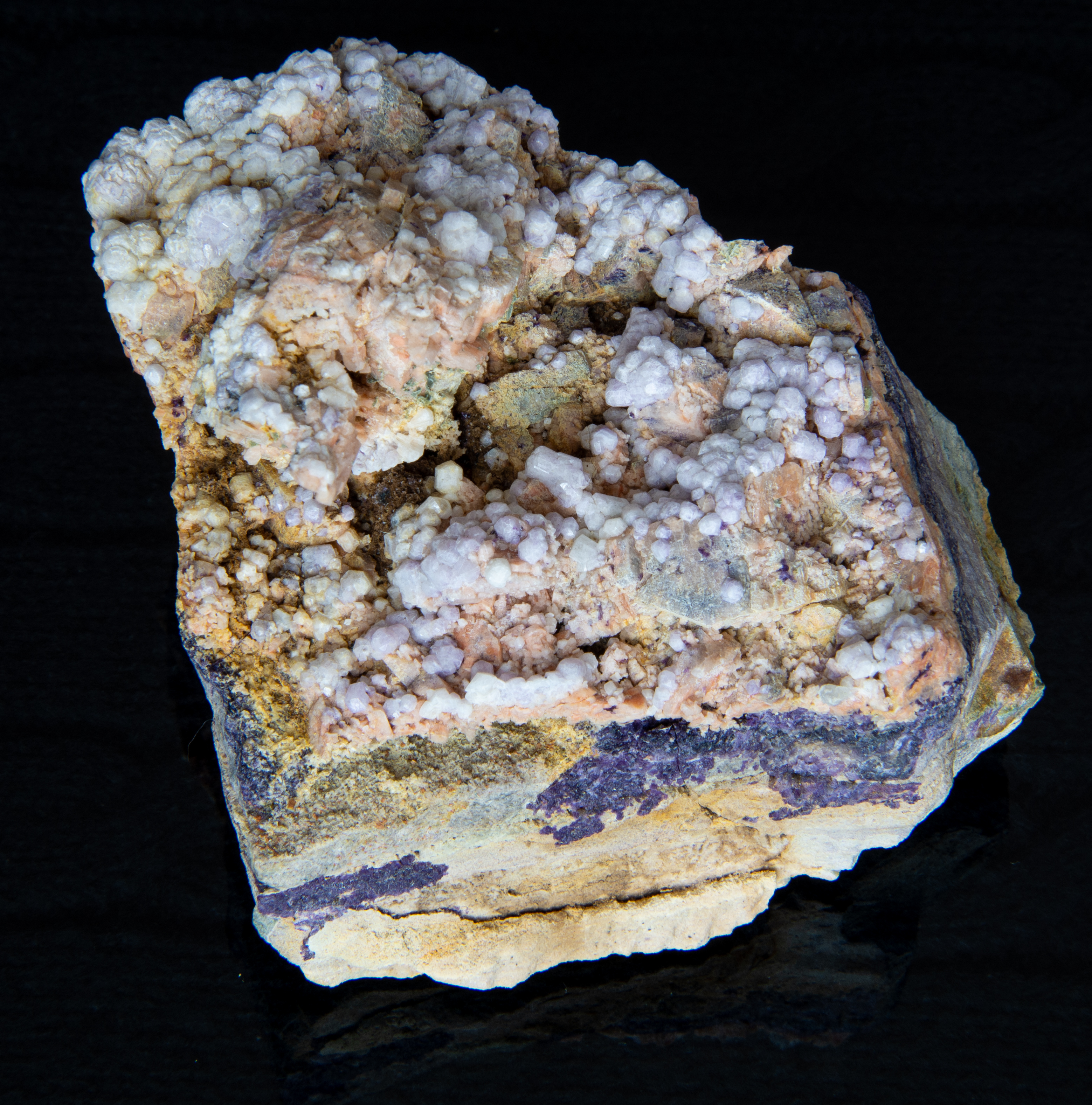
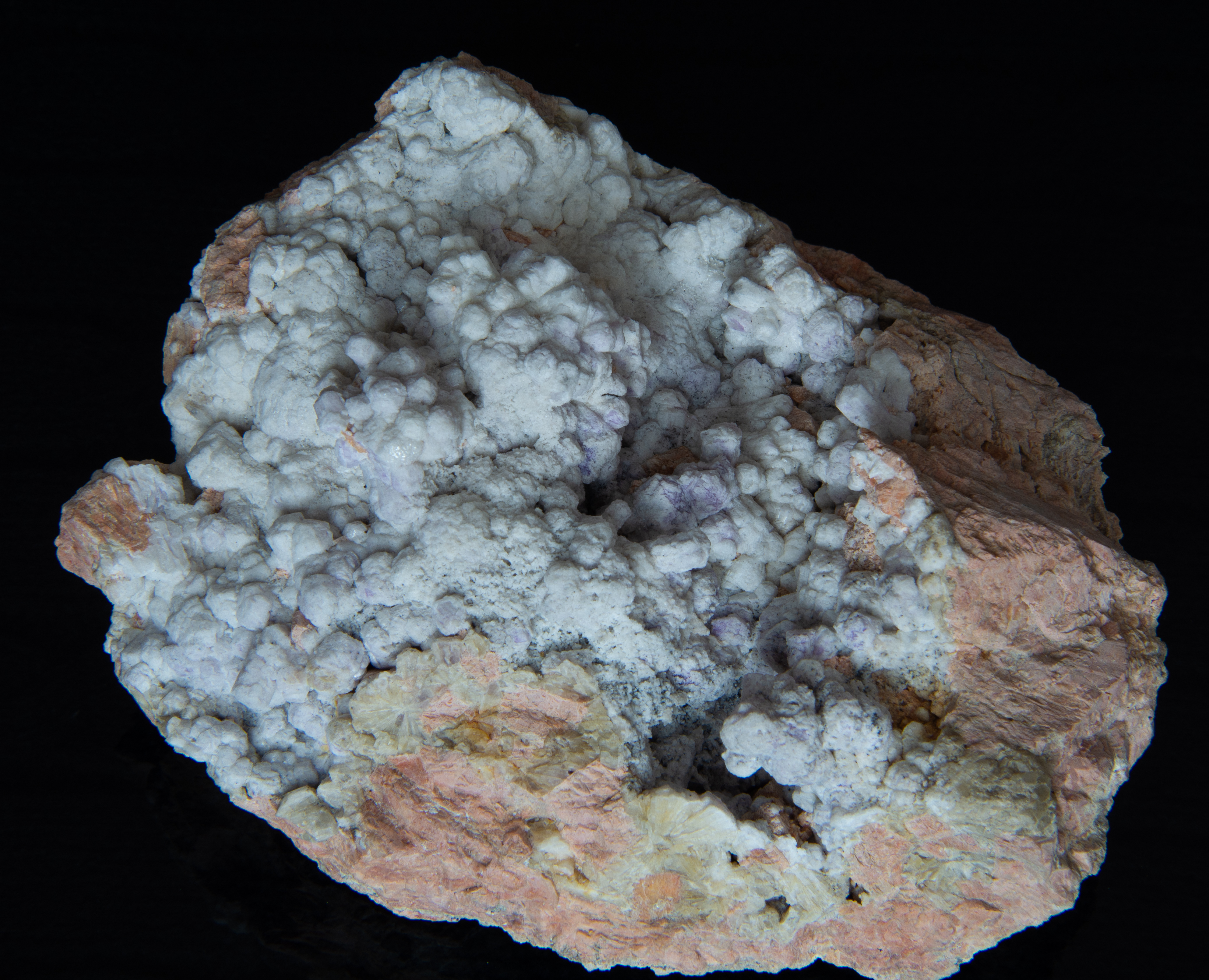
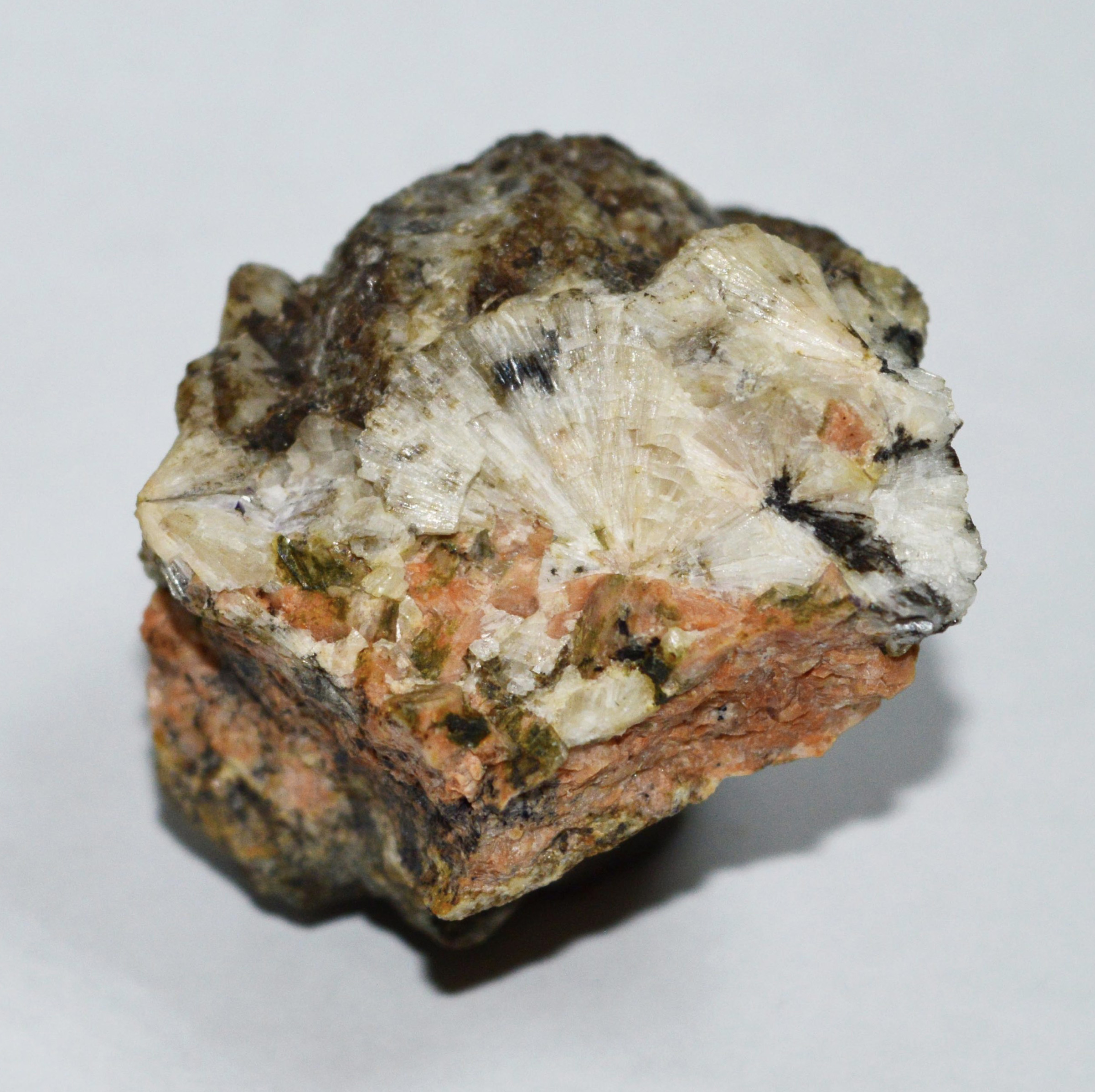
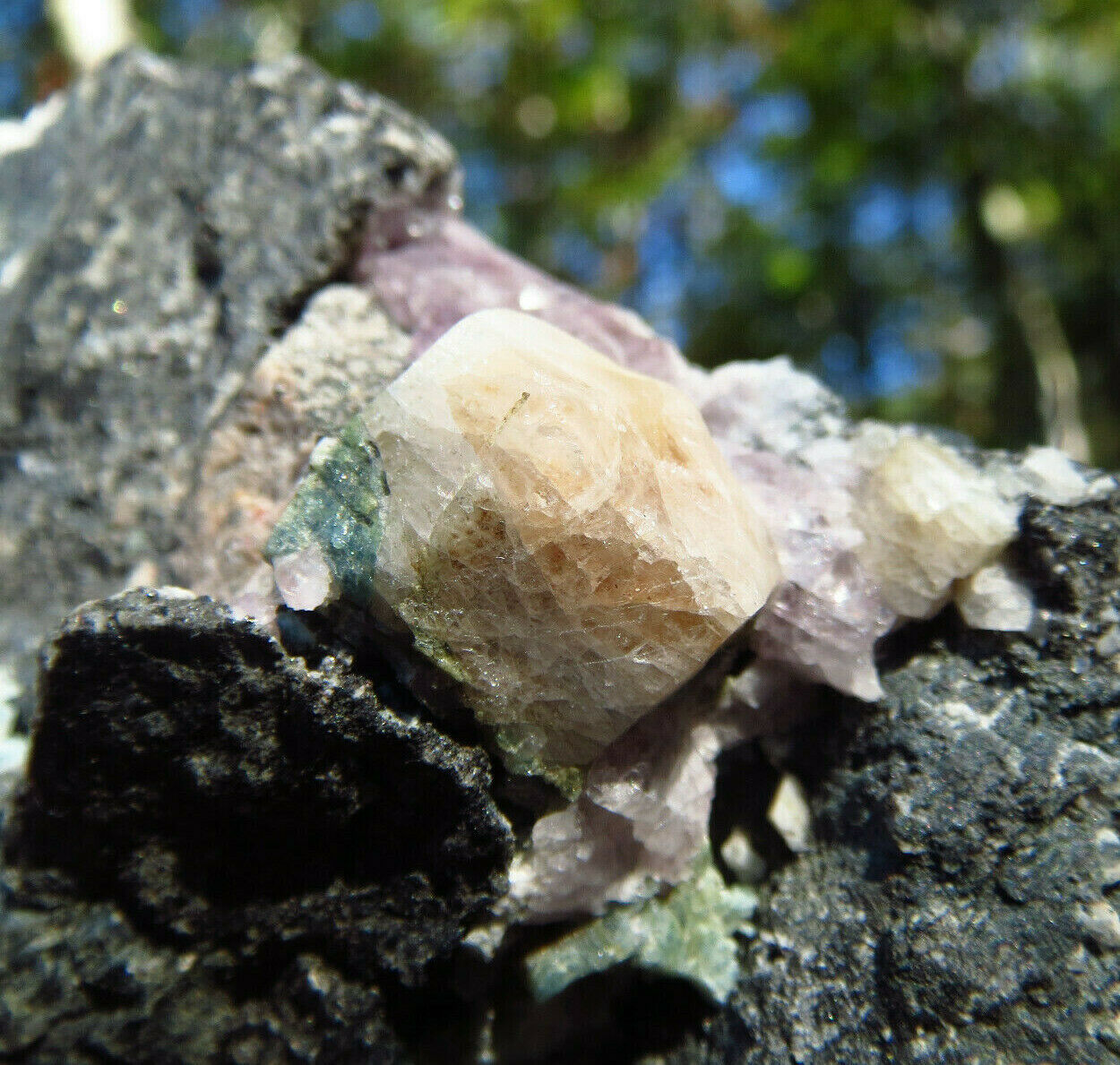
Fluorine is the most electronegative element on the periodic table. Where it substitutes into the phenacite framework it contracts the unit cell and strengthens the surrounding bonding, producing a denser, more rigid structure than ordinary phenakite (Be2SiO4). The result is a crystal that is measurably harder, denser, and more optically active than its fluorine-free parent.
Like its parent, fluorphenacite is optically uniaxial positive, with refractive indices of roughly nω 1.654 and nε 1.670 — a birefringence near 0.016 that the fluorine substitution raises slightly above pure phenakite. In clear crystals this produces a crisp doubling of the back-facet edges when viewed under magnification.
A specific gravity of about 2.96–3.00 and a Mohs hardness of 7.5–8 make fluorphenacite both unusually dense and unusually hard for a beryllium silicate — durable enough to take and hold a high polish while strongly resisting scratching.
Fluorphenacite is one of the rare stones whose field does not settle into a single point in the body at all, but in the transpersonal space the chakra map calls the Universal centre — the ninth, where individual awareness opens into the felt sense of the planet as one living being and of all humanity as a single family. Held anywhere on the upper body, it produces a widening rather than a rising: the boundary of "me" grows quiet and porous, and what is left is a clear, joyful field of belonging that plainly includes far more than the person holding the stone.
One Family, One LightThe Love and Joy that run through its signature do not soften one chakra so much as dissolve the felt separation between oneself and everything alive. This is the distinctive flavour of the Universal centre: not personal affection but a wide, impersonal warmth — the recognition that the same awareness looking out of these eyes is looking out of every other pair. It is the energy the Tamil siddha Vallalar spent his life pointing toward, the Arutperunjyothi or Vast Grace-Light that he held to be the one substance of all beings.
"God is the supreme Light that pervades all beings. All humans are one family, united by the light of grace."
— Vallalar (Ramalinga Adigal)
At a frequency of 9, fluorphenacite works on the very finest layers of an issue — the subtle, near-root karmic and ancestral material rather than surface emotion. With Power at 9 a small piece is more than sufficient, and Duration at 9 means it keeps working continuously, through sleep and through ordinary activity, long after you set it down. This is what separates the fluorine-rich form from ordinary phenacite: the same fine work, but transmitted with more force and held far longer, so that one layer after another is loosened and released without effort on the part of the practitioner.
Life, Joy, and the Rising FireWhere the Kundalini and Life currents are present, the cleared channel does not simply empty — it fills with vitality and an uncaused joy, the spaciousness that is left when a blockage finally goes. Fluorphenacite is gentle for a stone of this rank, but it is not idle; it keeps the fire moving cleanly rather than forcing it. Pair it with a grounding stone early in practice, when the field is still being established; later, when you are ready to meet the light on its own terms, it asks for nothing alongside it.