
Al2(PO4)F2(OH)·7H2O
The outer surface of the heart opens first — everything behind it follows.
The mineral was described in 1825 by the French mineralogist Armand Lévy from specimens collected at the Stenna Gwynn tin mine, St Columb Major, Cornwall, England. The name — properly spelled Fluellite in IMA nomenclature, though the single-l form Fluelite is widely used in collector literature — derives from the mineral term fluor or fluorine, which itself traces to the Latin fluere (to flow), a reference to the use of fluorite as a smelting flux in early metallurgy. The -ite suffix follows standard mineral naming convention. The name thus signals the mineral's defining characteristic: the presence of fluorine in its structure, which sets it apart from the many other hydrated aluminium phosphates with which it can be confused in the field.
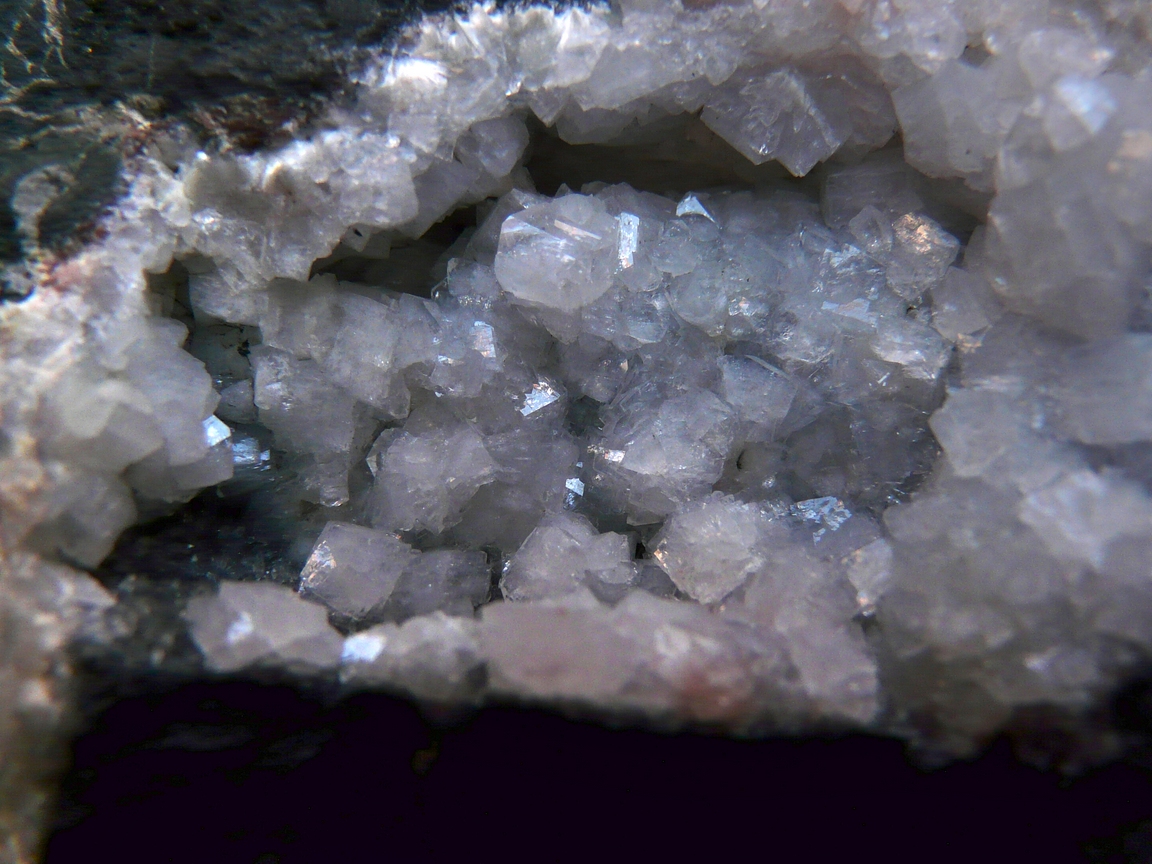
Fluelite is a hydrated aluminium phosphate fluoride, its formula incorporating two aluminium atoms, one phosphate group, two fluoride ions, one hydroxyl, and — unusually — seven water molecules, all integral to the crystal structure rather than merely surface-adsorbed. The orthorhombic symmetry (space group Fddd) imposes a characteristic dipyramidal crystal habit: two sharp pyramids joined at their equatorial girdle, producing crystals that look as if they have been carved and faceted by hand. Prismatic and tabular forms also occur, sometimes in radiating or drusy clusters on matrix.
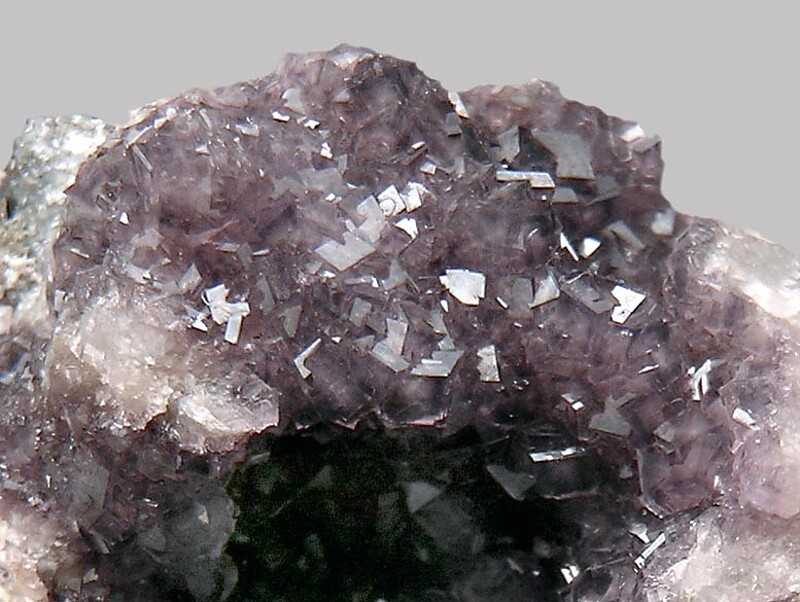
Colour is typically colourless, white, or pale yellow, but the most sought-after material shows a delicate pale pink to soft lavender, produced by trace amounts of manganese or iron substituting in the aluminium sites. Luster is vitreous; transparency ranges from transparent to translucent. The mineral is relatively soft and has a density of approximately 2.17 g/cm³, reflecting its high water content and aluminium-dominated composition.
The type locality — the Stenna Gwynn mine near St Columb Major in Cornwall — was historically worked for tin and copper, and fluelite formed there as a late secondary mineral in the oxidised upper reaches of the ore body, where phosphate-bearing groundwater interacted with aluminous host rock in the presence of residual fluorine from the granite's hydrothermal fluids. Cornwall's granitic terrain is one of the mineralogically richest small regions on Earth: the same fluorine-and-metal-charged hydrothermal systems that produced its famous tin, tungsten, copper, and arsenic ore deposits also generated dozens of rare secondary phosphate, arsenate, and fluoride minerals found in few other places.
Beyond Cornwall, good specimens have been recorded from Svappavaara in Norrbotten, Sweden; from Ehrenfriedersdorf in the Erzgebirge (Ore Mountains) of Saxony, Germany; from the Rapid Creek area of Yukon, Canada, which is renowned for exceptionally diverse phosphate mineralogy formed in iron-phosphate nodules within black shale; and from Greenbushes in Western Australia, a major lithium-tantalum pegmatite district that also yields a wide range of secondary phosphates. In all its occurrences, fluelite is a rare and small-quantity mineral, produced only where the geochemical conditions for its specific aluminium-phosphate-fluoride chemistry happen to coincide.

Most phosphate minerals contain only the PO4³⁻ anion balanced by cations, with no halide. Most fluoride minerals, conversely, contain only F⁻ as the primary anion. Fluelite achieves the unusual combination of both in a single charge-balanced structure — two fluoride ions alongside one phosphate group and one hydroxyl, all held together by two aluminium atoms. This places it in the small and chemically distinctive subset of fluorophosphates, minerals that require the simultaneous availability of both phosphate-bearing solutions and significant free fluoride in the geological environment — a geochemical coincidence rare enough to explain why fluelite is found in so few places on Earth.
The orthorhombic symmetry of fluelite, combined with the dominance of its {111} crystal faces, produces a characteristic double-pyramid habit — two sharply terminated pyramids joined at a common equatorial plane — that is so geometrically precise it consistently surprises viewers who encounter it for the first time. Unlike most minerals whose natural crystals require some imagination to connect to the idealized forms in textbooks, fluelite grows as almost perfect bipyramids without human intervention. Fine specimens with transparent, gem-bright crystals in pale pink or lavender look less like raw minerals and more like tiny, exquisitely cut gemstones left on the matrix by accident.
With seven H2O molecules per formula unit built into the crystal lattice — not adsorbed on the surface but structurally incorporated and essential to the framework's stability — fluelite occupies an unusually high position on the scale of mineral hydration. Its water content (by molecular count) rivals that of some zeolites and aluminosilicate frameworks far more complex in overall composition. This structural water is chemically inert under normal conditions, but it means the mineral's architecture is fundamentally aqueous in character: a crystal built as much of water as of any solid phase, with the two interwoven inseparably at the atomic scale.
"Love is essentially self-communicative: those who do not have it catch it from those who have it."— Meher Baba
Fluelite is almost shy. Its colour is barely there — a pink or lavender more felt than seen, like the light inside a cloud at dawn — and it works the way that light works: by arriving, not by pressing. It reaches high, beyond the body's ordinary range, yet the love in it draws all that altitude gently down into the chest, and there it does one specific, tender thing. It opens the outer surface of the heart, the guarded skin through which every real meeting with another person must first pass, easing the low, habitual bracing most people no longer even notice they hold.
It is the gentlest of touches — it breaks nothing and forces nothing; it rests on the guardedness and lets it soften in place — and it keeps its own clarity always, never needing to be cleansed, never taking on the heaviness around it, so it can keep this quiet work going for a long while. What it opens is the gate, not the whole house. The inner chambers of the heart answer to deeper allies — rhodochrosite, ferrinatrite, mazzite — while rhodizite holds the whole field bright and wide; together they leave the heart open at every depth, from its outer skin to its innermost silence, the whole of it in light.
"If you want the Grace of God, you sit before the lamp because God is in the form of Light now."— Vallalar (Ramalinga Adigal)