

BeAlSiO4(OH)
Clear sight, and the courage to act on it
Euclase was named by the French crystallographer René Just Haüy from the Greek eu (“easily”) and klasis (“fracture”), after its single, perfect cleavage — the very quality that makes the gem so beautiful also makes it perilous to cut.
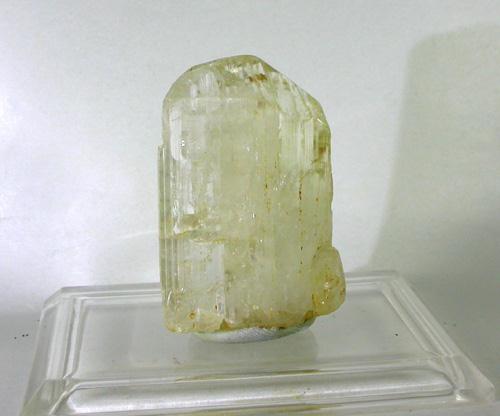
Euclase is a hydrous beryllium aluminium silicate, BeAlSiO4(OH), crystallising in the monoclinic system as elegant prismatic crystals. It is hard — about 7.5 on the Mohs scale — and ranges from colourless through pale to deep blue, green and aquamarine tones, the rich cobalt-blue stones being the most prized.
Its defining feature is a single perfect cleavage: the crystal splits cleanly in one direction, which is exactly what its name describes. The beryllium it contains is locked safely within the hard silicate lattice.
Euclase was first described in 1792, from material reported from the Ural Mountains of Russia. Its prime source for gem and specimen crystals, however, is Ouro Preto in Minas Gerais, Brazil, often cited as the type locality.
It is a secondary mineral, typically formed by the alteration of beryl in granite pegmatites and gem gravels; superb deep-blue crystals also come from the Last Hope mine in Zimbabwe.
Named for the single, perfect plane along which it splits — clean and decisive, the gem that breaks exactly true.
A hard, transparent beryllium silicate in pale-to-deep blue and green — a scarce, prized cousin of aquamarine and emerald.
It grows where beryl alters in pegmatites and gem gravels, gathering its blue from traces left in the weathering rock.
"When you reach the point where you see no difference between meditation and non-meditation, that is the fruit of the Great Perfection."— Khenpo Acho
Euclase works at the third eye — the centre of insight, inner vision and clear perception. Its frequency is high enough to reach into the finer layers, though its power is gentle and it stays a fair while. This is the seat of its old name as a stone of integrity, one that helps a person see the consequences of their actions clearly and stand in the truth — the same clean, true cleavage that defines the mineral, carried into the way one sees.
As a Healing stone its energy settles on one place and dissolves the issue there rather than moving it about; here, working at the brow, it clears the distortions and self-deceptions that cloud honest sight, so perception comes back into focus. And as a stone of Life it feeds that centre with vitality, lifting the foggy dullness that blurs discernment, so the inner eye is not only open but bright.
"Silence is truth. Silence is bliss. Silence is peace. And hence Silence is the Self."— Ramana Maharshi
And beneath clear seeing waits Joy — the thoughtless, unfiltered gladness that arises of itself once the mind grows quiet and honest and stops clouding the view. Euclase does not force a vision; it simply clears the glass, and in that clarity both truth and quiet happiness are easier to find.