
CaB(SiO₄)(OH)
Sleeping on clouds, softening everything until only gentleness remains
The name datolite comes from the Greek δατεῖσθαι (dateisthai), meaning "to divide" — a reference to the granular texture of massive varieties of the mineral, which appear as if the material has been divided or broken into tiny fragments. The mineral was first described in 1806 by the Swedish chemist Jöns Jacob Berzelius, who characterized it from specimens found at Arendal, Norway. Berzelius chose the name to distinguish the granular, dull massive datolite from the transparent crystalline forms, which in fine specimens can appear almost glass-like in clarity.
Datolite is a calcium boron sorosilicate with isolated SiO₄ tetrahedra linked by BO₄ groups and calcium in irregular eight-fold coordination. The boron is fourfold coordinated by oxygen, making datolite one of the relatively rare minerals in which boron occurs in tetrahedral rather than triangular coordination. The structure belongs to the monoclinic prismatic class (point group 2/m), which is centrosymmetric. Crystals are typically short prismatic to wedge-shaped, with complex combinations of prism, pyramid, and pinacoid faces that give individual crystals a very characteristic appearance unlike most other minerals.
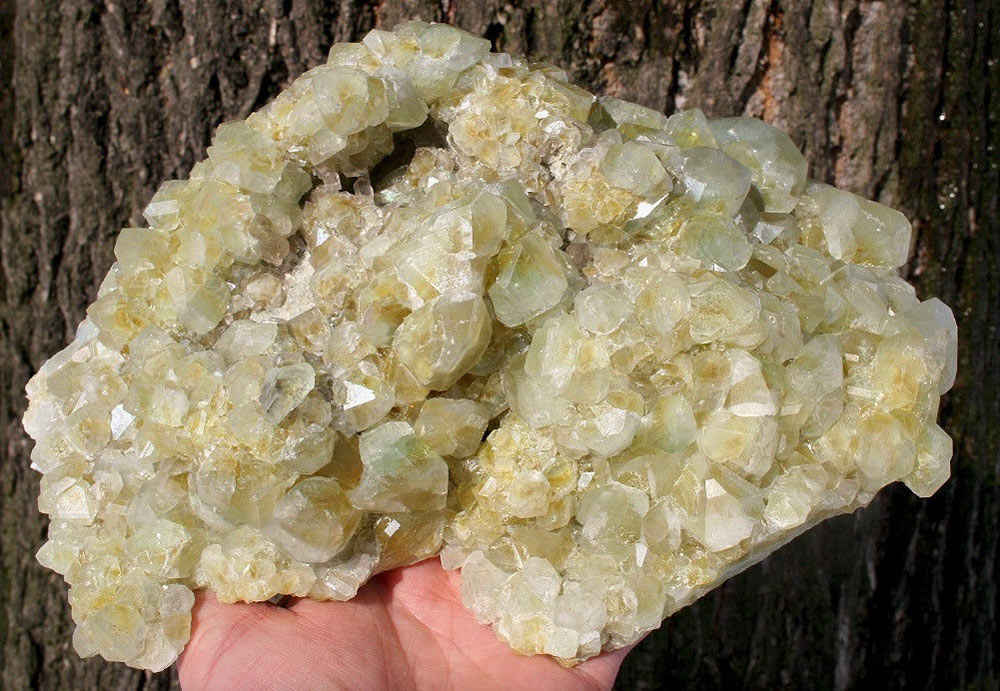
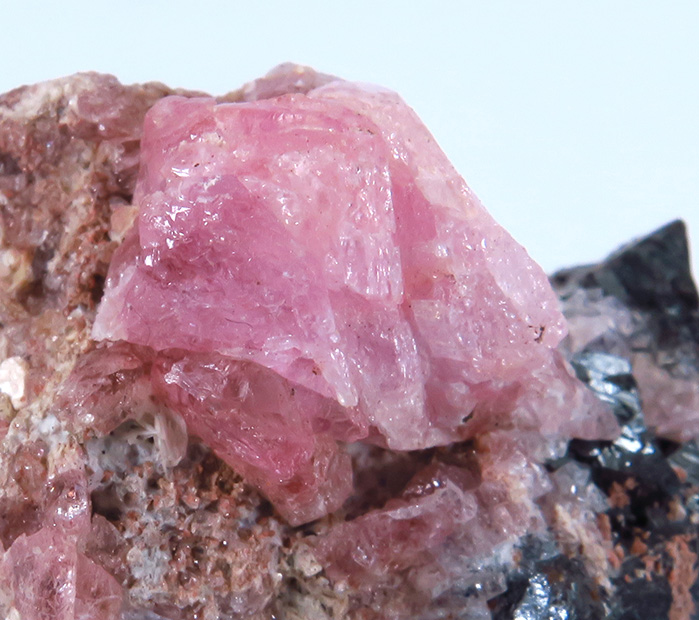
Colors include colorless, pale yellow, pale green, white, and the prized pale pink variety. The pink color arises from trace manganese substitution and is best developed in specimens from manganese-rich skarn deposits such as the Wessels Mine in South Africa. Luster is vitreous and the transparency in crystalline specimens can be high.
Datolite was first described from Arendal, Norway in 1806 and has subsequently been found at many localities worldwide. It occurs as a secondary mineral in cavities and veins in mafic igneous rocks — particularly in basaltic lava flows and diabase intrusions — as well as in skarns and metamorphic terrains. The famous trap rock quarries of the northeastern United States (New Jersey, Connecticut, Michigan) produced spectacular pale green massive datolite "blobs" used as ornamental stones. Crystalline specimens come from Norway, Germany, the Czech Republic, Austria, and Russia.
The finest pink datolite comes from the Wessels Mine, North Cape Province, South Africa — a manganese-rich skarn deposit that also produces sugilite, poldervaartite, and other rare pink minerals. The pink datolite from Wessels is the heart variety — the most powerful form energetically.
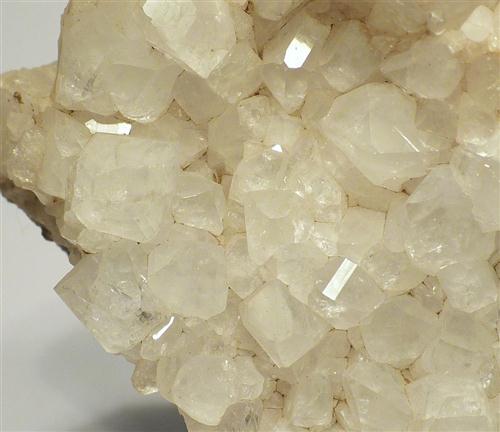

Datolite crystallizes in the prismatic class of the monoclinic system (point group 2/m), characterized by a single two-fold rotation axis and one mirror plane perpendicular to it. The resulting crystal habit is among the most complex in the mineral kingdom — individual crystals often display 20 or more distinct face types simultaneously, producing wedge-shaped, pseudo-orthorhombic forms that are highly characteristic of the species. No two datolite crystals are ever exactly alike.
Datolite is optically biaxial negative with refractive indices α = 1.622, β = 1.640, γ = 1.650 and birefringence 0.028. The moderate birefringence means that in thin section under crossed polarizers it displays first-order interference colors. The optic axial angle (2V) is approximately 74°, making it clearly biaxial. The mineral is colorless in thin section unless Mn-bearing (pink varieties show slight pink tint under plane light).
In most boron minerals, boron occurs in triangular BO₃ coordination — a flat, three-connected arrangement that is the norm for borate chemistry. In datolite, boron is tetrahedrally coordinated by four oxygen atoms (BO₄), sharing a corner with the adjacent SiO₄ tetrahedron. This is the same coordination boron adopts in danburite (CaB₂Si₂O₈) and creates a structural kinship between these minerals. The BO₄ unit makes the structure stronger and the mineral harder than typical borates, while fundamentally linking datolite's chemistry to that of the silicates.
"Don't worry, be happy."— Meher Baba
Very soft and nice — like entering a dream world, like sleeping on clouds. It simply softens life and calms the body. So this one earns its place not for power or frequency but because it is the softest crystal in the top 100, and that softness has an extraordinary power behind it.
Colour and ChakraThe green and yellow clusters sink the datolite energy lower, into the belly; the clear datolites centre more in the head. The pink ones are the heart datolites — and they are the best. In that softened, dreamlike calm the grip of the busy mind loosens, and the wider picture and old memories can surface gently of their own accord — the heart's own quiet doorway onto the Akashic field.
"To be relaxed and let go in the moment of recognizing — that is the most important thing."— Tulku Urgyen Rinpoche
The pink datolite from the Wessels Mine in South Africa is the finest expression of datolite's heart energy. It is very soft, yet loving and caring — working at the Heart, the Anahata, as pure heart-feeling without agenda or direction, simply softening whatever is there. Where many heart stones open or activate, datolite dissolves: not the pain or the protection, but the hardness — the holding itself. What remains, once everything is soft, is the heart's natural state — open, present, undisturbed.