
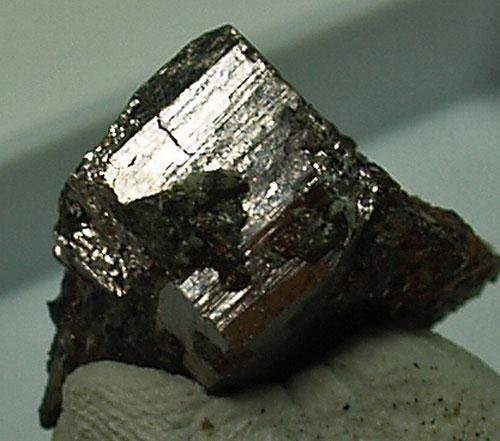
CoAsS
Walls falling, the creative fire let loose
Cobaltite is named simply for its essential metal, cobalt. The metal's own name has a vivid origin: German miners called troublesome cobalt-bearing ores Kobold, after the mischievous goblin of folklore, because the ores looked like valuable silver or copper but yielded none, and gave off poisonous arsenic fumes when smelted — as if a malicious sprite had cursed them.
So the name carries a memory of the metal's difficult reputation among early miners, long before cobalt became valued for its brilliant blue pigments and, later, its modern industrial uses.
Cobaltite is a cobalt sulfarsenide, CoAsS, crystallising in the orthorhombic system but very nearly cubic in symmetry, so that it forms handsome pseudo-cubic, octahedral and pyritohedral crystals strongly resembling pyrite. Cobalt bonds with paired arsenic and sulfur in a structure echoing pyrite's, giving silver-white to reddish, metallic, opaque crystals of moderate hardness (Mohs 5.5) and considerable density.
It forms in high-temperature hydrothermal veins and contact-metamorphic deposits, often alongside other cobalt, nickel, copper and arsenic minerals. As the principal ore of cobalt it is economically important; because it contains arsenic it should be handled cleanly — not ground, inhaled as dust, or ingested — with hands washed after handling.
Cobaltite has been known for centuries from the cobalt-mining districts of Europe, with classic localities in Sweden (Tunaberg, Håkansboda), Norway, England (Cornwall) and Germany, where cobalt ores were sought for the deep blue smalt and cobalt-blue pigments used in glass and porcelain.
Today fine crystals come especially from the Cobalt district of Ontario, Canada, from Morocco's Bou Azzer — one of the few places where cobalt is mined as a primary product — and from Australia, Sweden and elsewhere. As demand for cobalt has grown, cobaltite has gained renewed importance as an ore, while sharp, brilliant crystals remain prized by collectors.
Cobaltite is a chief source of cobalt, the metal behind centuries of deep-blue glass and porcelain pigment — and today behind the batteries of the modern world. Its mischievous "goblin" name remembers how hard it once was to win.
Orthorhombic yet nearly cubic, cobaltite forms crisp silver-white pseudo-cubes and octahedra that closely resemble pyrite — geometry caught just at the edge of true cubic symmetry.
Cobaltite pairs sulfur with arsenic in a pyrite-like framework around cobalt — a sulfarsenide rather than a simple sulfide, one of the dense, metallic, structurally intricate ore minerals.
"Ecstasy is our very nature; not to be ecstatic is simply unnecessary. It needs no effort to be ecstatic; it needs great effort to be miserable."— Osho
Cobaltite is a stone for breaking through walls. Its frequency sits at the sacral centre — the watery seat of desire, emotion and creative flow, the source of a person's "creative juice" — and its named work is to break through limitations and mental walls and to free creative expression. The blocks it addresses are exactly the dams that hold that creative current back: the inner limits, the rigid mental structures that say this far and no further.
Its current is Kundalini, and this is how the walls come down. The risen fire moves up through the central channel, burning away blockage indiscriminately, widening the pipe so energy can flow more freely — and at the sacral, where creativity lives, that means the dammed creative force is released. Cobaltite lends the kundalini its steady, breaking strength here.
Its Duration of eight makes it a long companion, working day and night the way the kundalini does, returning to the limitations again and again until they give way. So its gift is liberation of flow: walls dissolved, the creative current set loose, the energy that was held back finally moving and expressing itself.
"The mind is the cause of both bondage and liberation. To control it is the greatest victory."— Trailanga Swami