
BeAl2O4
Quiet worth that needs no proving
The name chrysoberyl joins two Greek words: chrysos, gold, and beryllos, beryl — literally "golden beryl," for the honey-to-greenish-gold colour of the classic stones. The name is a historical misnomer: chrysoberyl contains no beryllium silicate and is not a member of the beryl family at all, but a beryllium-aluminium oxide. The resemblance was one of colour and lustre, not chemistry.
Its two great varieties carry their own names. Alexandrite honours the future Tsar Alexander II of Russia, the colour-change variety having reportedly been found on his coming-of-age day in 1834. Cymophane — the cat's-eye variety — comes from the Greek kyma (wave) and phainein (to appear), describing the rippling band of light that floats across its surface.
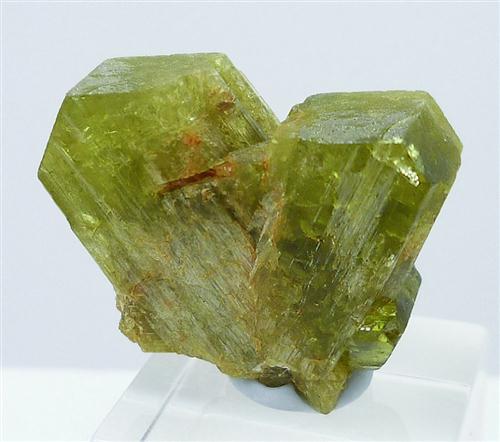
Chrysoberyl crystallises in the orthorhombic system as BeAl2O4, the type mineral of its own small oxide group. Aluminium and beryllium occupy ordered sites within a close-packed framework of oxygen, an arrangement that packs the atoms tightly and gives the mineral its remarkable hardness of 8.5 on the Mohs scale — harder than topaz, bettered among common minerals only by corundum and diamond. Crystals frequently form repeated twins, producing pseudo-hexagonal "trillings" of striking sixfold symmetry.
Two optical phenomena set chrysoberyl apart. When trace chromium replaces a little aluminium, the crystal absorbs light in a way that makes it appear green in daylight and red under incandescent light — the alexandrite effect. When the stone is threaded with countless parallel rutile needles or hollow tubes and cut as a cabochon, that fibrous structure reflects a single sharp line of light: chatoyancy, the cat's-eye.
Chrysoberyl was formally described in 1789 by the German geologist Abraham Gottlob Werner, though the stone had been cut and worn long before it was named. It forms in beryllium-rich, aluminous environments — granitic pegmatites, mica schists, and their weathered gem gravels — where slow growth at high temperature allows its hard, well-ordered crystals to develop.
The legendary colour-change alexandrite was first recovered in the 1830s from the emerald-bearing mica schists of the Ural Mountains in Russia. Today the species is drawn from many sources: Brazil (especially Minas Gerais), Sri Lanka, Madagascar, Myanmar, Tanzania, and Zimbabwe. Sri Lanka and Brazil supply the finest cat's-eyes, while the most prized alexandrites still trace to Russia and Brazil.
Chrysoberyl is one of very few minerals to host two celebrated optical effects: the alexandrite colour change and the cat's-eye. Both arise from impurities and inclusions rather than the base chemistry — the same hard, clear host quietly performing two different kinds of light-play.
With a Mohs hardness of 8.5, chrysoberyl sits in the narrow band between topaz and corundum. Among readily available gem minerals only sapphire, ruby and diamond are harder, making chrysoberyl one of the most enduring stones a person can carry.
Despite its name, chrysoberyl belongs to the oxide class, not the silicates. It is the type mineral of its own group and one of the few common gem species built on beryllium and aluminium oxide — a quietly rare chemistry behind a familiar golden face.
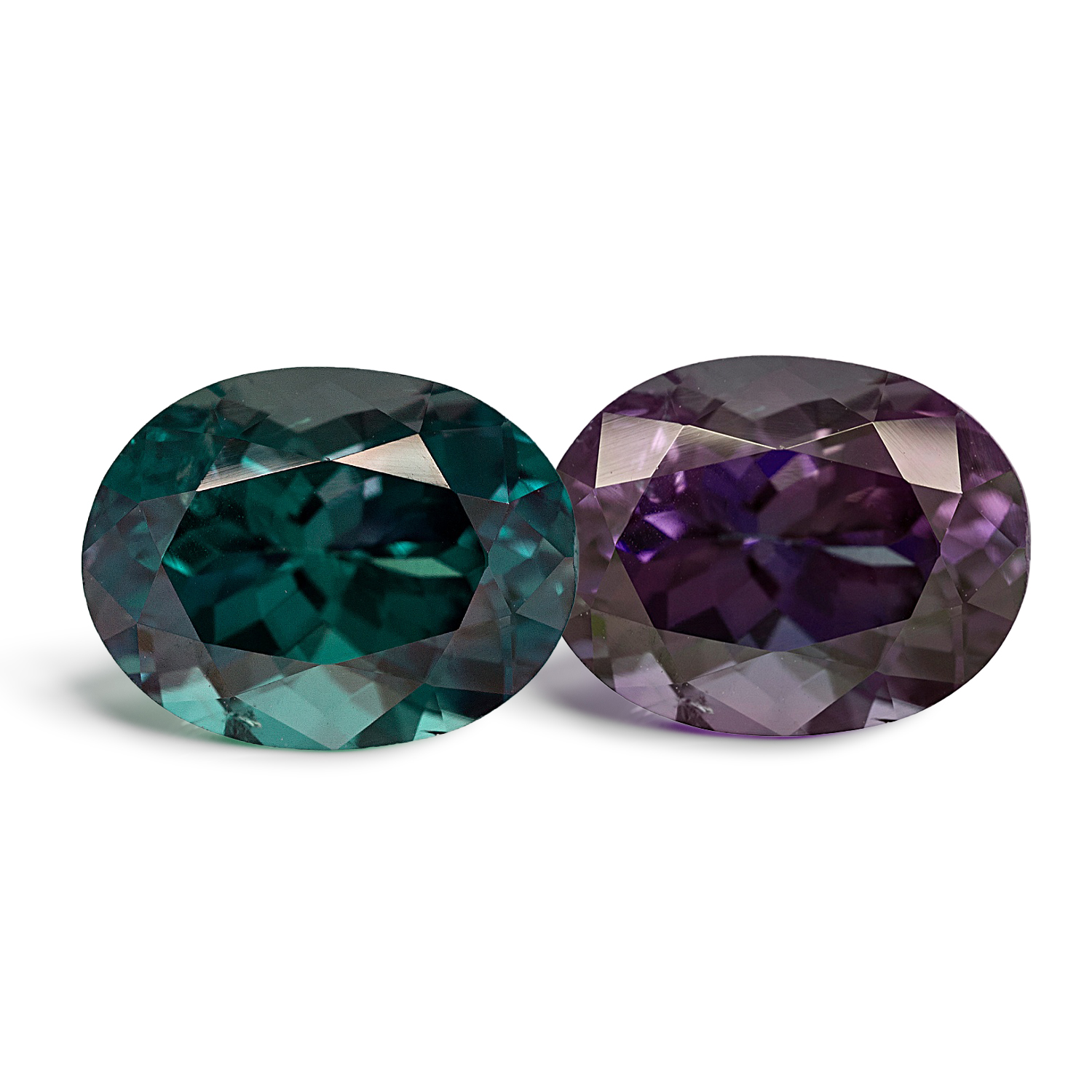


Of all chrysoberyl's faces, none is as famous — or as coveted — as alexandrite, the colour-change variety that seems to be two gems in one. In daylight it glows a cool blue-green; carry it indoors under a lamp or a candle and the very same stone turns a warm raspberry-red to purple. The old gem-trade saying captures it perfectly: emerald by day, ruby by night. Fine, strongly-changing alexandrite is among the rarest and most valuable of all coloured gems.
Why It Changes ColourThe magic is chromium. When a trace of chromium (Cr3+) slips into the aluminium sites of the crystal, it absorbs light right in the middle of the spectrum — the yellow band — while letting both green and red pass through. That leaves the stone balanced on a knife-edge between two colours, and which one you see depends entirely on the light. Daylight and fluorescent light are rich in blue, so the eye reads the green; the warm, red-heavy glow of an incandescent bulb or candle tips the balance the other way, and the red emerges. This genuine shift of hue with the light source is the true alexandrite effect — distinct from pleochroism, where the colour changes with the viewing angle rather than the lighting. The cleaner that internal balance, the more complete and dramatic the flip.
Named for a TsarAlexandrite was first found in the emerald mines of the Ural Mountains in the 1830s and named for the young Alexander — the future Tsar Alexander II of Russia. Its two colours, green and red, happened to be the military colours of imperial Russia, and the stone was embraced as a national gem. Russian alexandrite remains the benchmark against which all others are still judged.
As Tough as Sapphire and DiamondBeauty aside, alexandrite is built to last. Chrysoberyl is exceptionally hard — 8.5 on the Mohs scale — so that among the gems people actually wear, only diamond (10) and sapphire and ruby (corundum, 9) are harder. It also lacks any easy cleavage plane, which gives it real toughness as well as hardness: it resists not just scratching but chipping and knocks. That combination places alexandrite in the same durability class as sapphire and diamond — a stone you can wear every day, pass down for generations, and find unmarked. Few coloured gems are so nearly indestructible.
"If you keep a light before a thousand people, it reaches all without making any distinction."— Nityananda
Chrysoberyl does its work at the throat — the gate between the heart and the mind, and the place where the ego builds its wall. That wall is not the ego itself but the guard it posts against judgement: the bracing against invalidation, evaluation, the verdicts of other people. Where the throat is held shut, expression stays small and the heart cannot reach the mind. Chrysoberyl is a Life stone here — it pours vitality straight into that centre, clearing the foggy self-doubt and drained, lethargic silence that keep a person quiet, and feeding the channel like a river restored to a dry bed.
Its frequency is steady rather than soaring, and it works by Healing — the energy stays on the issue rather than moving up or down, settling over the bruise of self-worth like a magnifying glass held to one spot until it dissolves. With a Duration of eight it is one of the long companions: it does not strike once and fade but returns to the wound while you sleep and work, peeling layer after layer until the foundation gives way.
What surfaces then is what the old descriptions promised — confidence, compassion, forgiveness, kindness. These are not added from outside; they are simply what remains when the throat no longer needs defending and a person can speak and stand in plain truth without first reaching outside themselves for permission.
"The winds of grace are always blowing, but you have to raise the sail."— Ramakrishna