

(Fe,Mn)AlPO4(OH)2·H2O
Where the voice grows fearless, the spirit grows larger
Named in honor of John George Children FRS (1777–1852), English mineralogist, chemist, zoologist, and keeper of natural history at the British Museum. The name was assigned by the Scottish chemist Thomas Thomson in 1823, following the standard 19th-century mineralogical convention of honoring distinguished scientists and collectors. Children was elected a Fellow of the Royal Society, helped found the Entomological Society of London, and built some of the most powerful galvanic batteries of his era — a man whose curiosity ran across the sciences as freely as the mineral honoring him moves across its solid solution series.
Childrenite is the iron-dominant end member of the Childrenite–Eosphorite series — a complete solid solution in which iron (Fe²⁺) and manganese (Mn²⁺) substitute freely for each other across the full compositional range. When iron dominates (>50% of the Fe+Mn site), the mineral is Childrenite; when manganese dominates, it is Eosphorite. Many natural specimens fall intermediate between the two named end members, their color and crystal habit shifting accordingly: iron-rich specimens tend toward yellow-brown and honey tones, while manganese-rich material leans toward pink and rose.
The orthorhombic structure builds around chains of AlO₄(OH)₂ octahedra linked by PO₄ tetrahedra — a framework typical of the hydroxyl phosphate group. Crystals commonly form as prismatic to tabular individuals, often in aggregates on matrix, and are frequently found growing on or alongside apatite in the complex phosphate-bearing pegmatites that are their geological home.
First described by Thomas Thomson in 1823 from specimens collected at Wheal Phoenix, a tin and copper mine near Liskeard in Cornwall, England — the type locality. Cornwall's granite pegmatites and hydrothermal veins have long supplied mineralogists with secondary phosphate species, and Childrenite was among the earlier ones formally characterized from this historically rich district.
Beyond Cornwall, notable localities include the Greifenstein and Hagendorf-Süd pegmatites in Bavaria, Germany — among the world's most mineralogically productive phosphate pegmatites — and several mines in Coquimbó, Chile. The mineral is always a secondary species, forming in the alteration zones of complex phosphate-rich pegmatites where primary phosphate minerals such as triphylite and lithiophilite have been oxidized and recrystallized. This geological environment — some of the most mineralogically complex rock in the world — places Childrenite in consistently distinguished company.
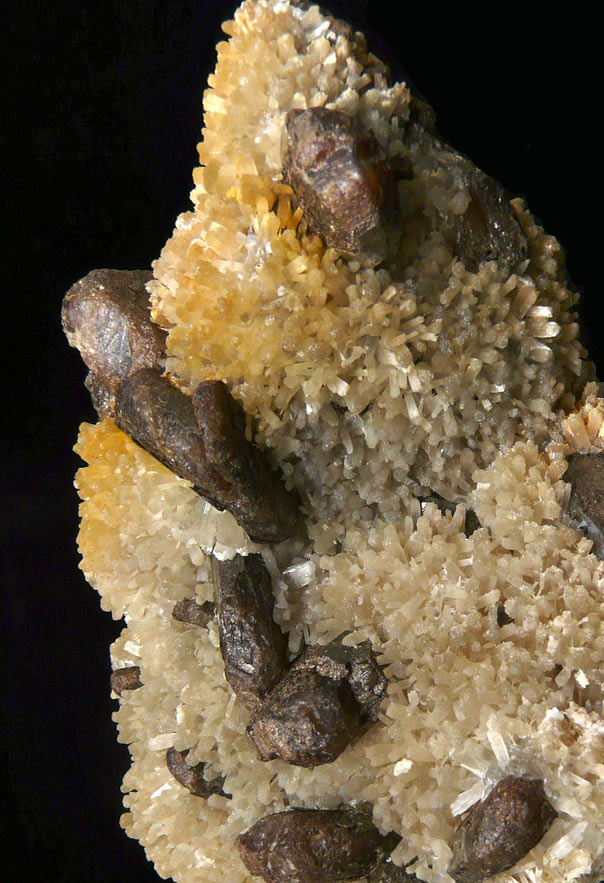
Childrenite and its manganese analog Eosphorite form a continuous compositional series with no structural gap between them. The same crystal architecture accommodates any ratio of Fe²⁺ to Mn²⁺ — the two elements are chemically similar enough that the lattice accepts both without distortion. This seamless range between two named species is relatively uncommon and reflects an unusual degree of structural flexibility in the phosphate framework.
Iron-dominant Childrenite typically presents in warm honey-yellow to reddish-brown tones; manganese-dominant Eosphorite tends toward pink and rose. Intermediate compositions produce every gradation between — a single mineral series spanning from warm amber through golden-brown to soft pink, the color index a direct readout of the Fe/Mn ratio within each crystal.
Childrenite forms exclusively in the secondary alteration zones of complex phosphate pegmatites — among the most mineralogically concentrated geological environments on Earth, where hundreds of rare species can occur within a single pocket. The conditions required to produce it are precise: specific temperature, specific chemistry, specific sequence of alteration reactions. The rarity that results is genuine and geological, not merely commercial.
Childrenite brings Life, Joy, and Healing to the Throat chakra — and it does so with an exceptional duration (D=8) that makes it one of the most patient and persistent companions in the phosphate family. Like Cerussite, it works through hours of daily life, through work and sleep, quietly continuing its healing without requiring active attention. But where Cerussite grounds from below, Childrenite opens from the front: it heals the Throat's accumulated silence, the years of unsaid truths, the words that were swallowed rather than spoken — and what emerges once that healing reaches sufficient depth is a quality that everyone who works closely with this crystal reports almost immediately: fearlessness.
Life and Joy at the Throat — The Instant OpeningThe first contact with Childrenite often produces a swift shift in the quality of awareness — the mind moves into the spiritual domain without the gradual warming-up that most crystals require. This is not the dramatic expansion of an Expanding-type crystal; it is something quieter and more complete: the ordinary mental field simply becomes transparent, and what was behind it — alive, joyful, undefended — is briefly obvious. The Life energy at the Throat carries this quality of immediacy: aliveness at the center of expression, a sense that the voice is backed by something real rather than performed.
The Joy that follows is not added happiness but the felt quality of the Throat's natural state when its blockages have been lifted — unobstructed, light, present without effort. Osho described it precisely: "Ecstasy is our very nature." At the Throat specifically, this naturalness expresses as the ease of saying what is true without bracing for consequences. The voice that needs no armor is the joyful voice.
"All the buddhas of all the ages have been telling you a very simple fact: Be — don't try to become."— Osho
What distinguishes Childrenite from other Throat crystals — and what makes it more potent than Spessartine, which offers creative fire at the sacral level — is the specific quality of fearlessness it produces. Spessartine gives boldness; Childrenite gives something deeper: the recognition that one's own perception is fundamentally trustworthy. New ideas no longer require external validation before they can be entertained. The mind can go somewhere it has not been, can hold a thought that others haven't thought yet, can speak from a position that hasn't been pre-approved — and none of this produces the familiar contraction of anticipated judgment.
Chogyam Trungpa called this "basic goodness" — not a moral quality but an ontological one: the ground of one's being is fundamentally sound, and once that is felt rather than merely believed, the energy spent on defensive self-maintenance becomes available for actual living. The warrior, in Trungpa's framework, is not someone without fear but someone who has stopped letting fear run the room. "The genuine heart of sadness" he called the open quality that remains when the cocoon drops — tender, exposed, but not brittle. Childrenite creates exactly this quality at the Throat: tender presence, undefended truth, the willingness to stand in a position without a safety net of pre-established agreement.
With D=8, this is a crystal that does not merely open this quality during a session — it rebuilds it structurally over time. Worn or carried daily, it gradually removes the habituated flinching that causes people to soften their truth before speaking it, to qualify the new idea into acceptability before offering it, to retreat from a position the moment it meets resistance. The standing that results is not rigidity but rootedness: the difference between a wall and a tree.
"The key to warriorship is not being afraid of who you are. Ultimately that is the definition of bravery: not being afraid of yourself."— Chogyam Trungpa Rinpoche