
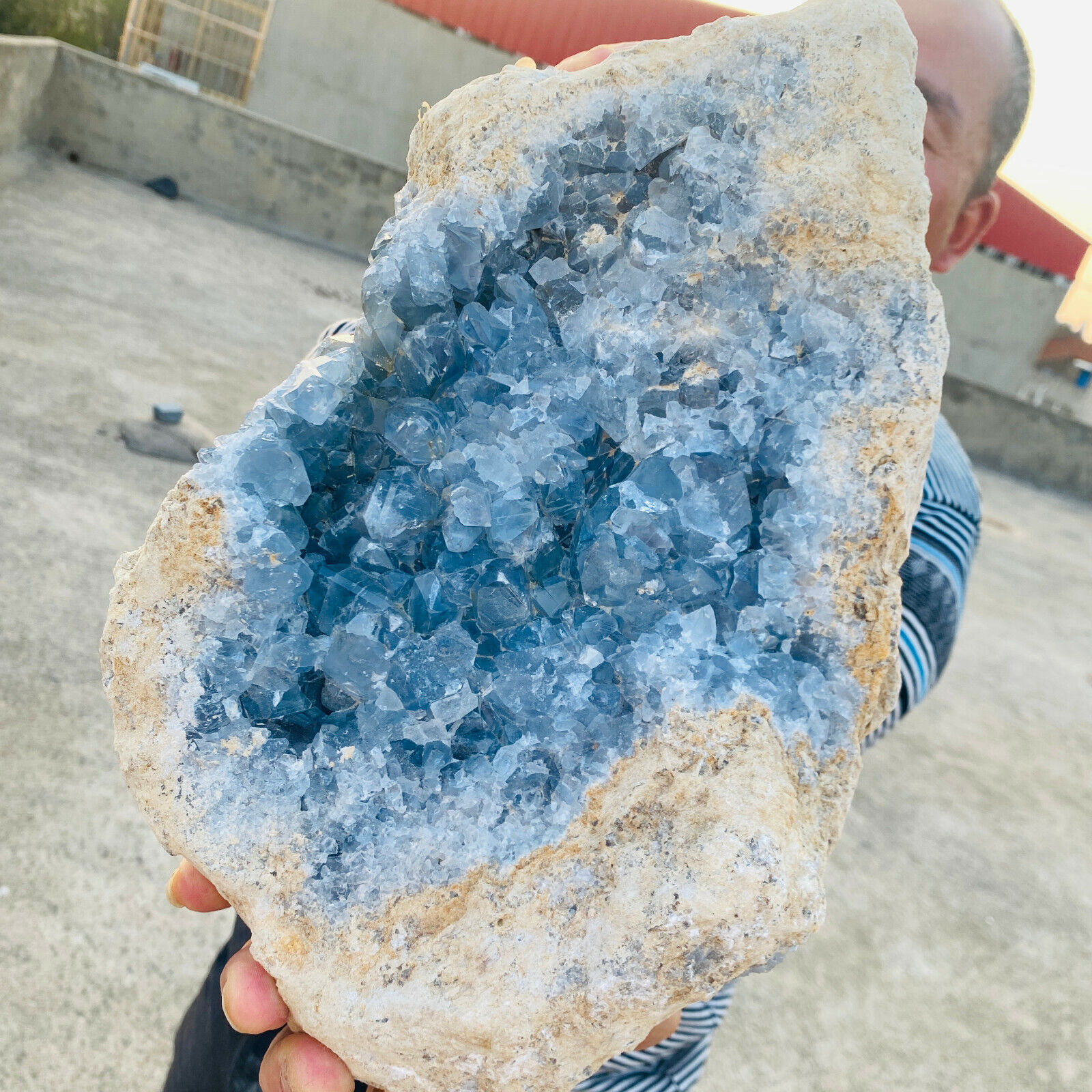
SrSO4 · Strontium Sulfate
a pale-blue serenity that lifts the inner eye toward the angelic
The name Celestine — sometimes written Celestite — derives from the Latin caelestis, meaning "celestial" or "of the sky," which in turn comes from caelum (sky, heaven, atmosphere). The name was given for the mineral's characteristic delicate sky-blue colour, which immediately suggests an open expanse of blue air. The alternate form Celestite (adding the standard mineralogical suffix -ite) appeared in older literature and remains in common use, though Celestine is the form accepted by the International Mineralogical Association.
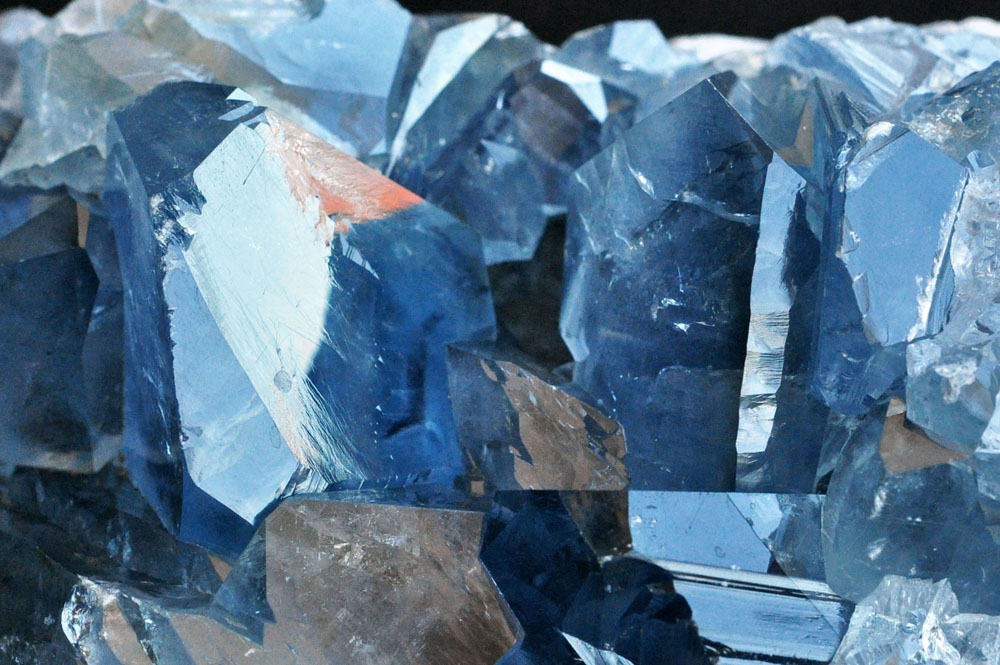
Celestine is a strontium sulfate (SrSO4) that belongs to the baryte group — the family of orthorhombic sulfates that also includes baryte (BaSO4) and anglesite (PbSO4). Its crystals grow as tabular, prismatic, or bipyramidal forms with a perfect cleavage on {001} and good cleavage on {210}. The lustre is vitreous to pearly on cleavage faces. Colour ranges from colourless and white through pale blue, grey, and occasionally yellowish or greenish; the characteristic sky-blue is caused by trace impurities rather than any structural colour centre, which is why prolonged sunlight gradually bleaches the blue away. Specific gravity is 3.95–3.97, noticeably heavy for a pale-coloured mineral. Celestine may contain minor calcium or barium substituting for strontium, linking it chemically to both baryte and anhydrite with which it commonly co-occurs in evaporite sequences.
Celestine occurs worldwide in sedimentary rocks — especially evaporite deposits — where it forms in association with gypsum, anhydrite, halite, and dolomite. Important commercial and specimen localities include Madagascar (the source of most of the fine pale-blue tabular crystals seen in the mineral trade), the former Yate deposit near Bristol, England (commercially mined until 1991), the Machow mine in Poland, Sicily, Ohio (USA), and various sites across Canada and Mexico.
The most celebrated single occurrence is the Crystal Cave geode near Put-in-Bay on South Bass Island, Lake Erie, Ohio — the world's largest known geode at roughly 11 metres (35 feet) in diameter. Its celestine crystals reach 46 cm (18 inches) across and individual crystals weigh up to 140 kg (300 lbs). The cave has been open to visitors since 1897 and remains one of the great mineralogical wonders of North America.
Celestine is the principal commercial ore of the element strontium, which is widely used in pyrotechnics (producing the brilliant crimson red of fireworks and flares), cathode-ray tube glass, and specialty metal alloys.
Celestine's signature pale sky-blue is among the most immediately recognisable colours in the mineral world. The vitreous to pearly lustre — especially striking on large cleavage faces — gives crystals an almost liquid, watery transparency. The blue fades in prolonged sunlight, a reminder that this colour is a delicate impurity effect rather than a structural property.
Celestine frequently forms spectacular geodes — hollow cavities lined with inward-pointing crystals — of a size and quality that few minerals can match. The Put-in-Bay geode in Ohio is the world's largest known geode, with crystals so large that early visitors could stand inside and be surrounded by pale-blue walls of crystal. Madagascar produces somewhat smaller but strikingly vivid blue geodes that are widely collected.
As the principal ore of strontium, celestine is the mineral behind the brilliant crimson red of fireworks, emergency flares, and signal rockets. Strontium salts burn with one of the most saturated reds achievable in pyrotechnics — a direct connection between this pale, serene crystal and the most vivid colours of celebratory fire.
The characteristic sky-blue of celestine is caused by trace impurities rather than a structural colour centre. Prolonged exposure to direct sunlight will slowly bleach the blue, eventually leaving colourless or pale grey crystals. Display in indirect or ambient light and avoid window ledges with long daily sun exposure. The fading is gradual and irreversible.
Celestine is very slightly water-soluble and will dissolve extremely slowly with sustained contact. Never use water or liquid solutions to clean celestine specimens; dry-dust only with a soft brush. Avoid storage in high-humidity environments over long periods. The dissolution rate is very low under normal conditions, but repeated wet-cleaning or prolonged immersion will gradually dull crystal faces and erode delicate crystal edges.
"The mind is nothing other than the 'I'-thought."— Ramana Maharshi
There is a quality of stillness that does not have to be manufactured. You do not go looking for it. It is already here, underneath everything — and celestine, if you sit quietly with it, seems to be pointing at exactly that. The stone says nothing dramatic. It is pale, soft, almost transparent. And that is precisely the point.
Who is it that feels the mental clutter? Stay with that question long enough, and the noise begins to thin on its own. Celestine works at the level of the inner eye — the place that can look at an issue directly and dissolve it simply by seeing it clearly, without adding commentary. The serenity it brings is not the serenity of suppression; it is the serenity of a mind that has been seen through. When the "I"-thought loses its solidity, what remains is a kind of luminous spaciousness — and celestine rests very naturally in that space.
Angelic AttunementCelestine has a longstanding association with angelic contact and with the feeling that one is not entirely alone in one's inner life — that there is something vast, gentle, and unhurried behind ordinary awareness. This is not a quality that needs to be reached or achieved. It is already present when the noise clears. The stone seems to support exactly that clearing: slowly, steadily, over the several hours or days it takes to work through a layer of stress or mental accumulation.
"A quiet mind is all you need. All else will happen rightly, once your mind is quiet."— Nisargadatta Maharaj
Celestine's energy moves outward. Once the inner eye begins to settle and clarify, the quality of serenity does not stay enclosed inside — it radiates. Stress dissolves not only in the centre of awareness but through the surrounding field, gently loosening the structures that keep worry and mental clutter in place. There is nothing forceful in this. Celestine works the way a clear sky works — not by pushing clouds away, but simply by being open. Carry it or sit with it and notice: the thinking does not have to be stopped. It simply has less to hold onto.