

SnO2
Grounded power, destiny taking shape
The name cassiterite comes from the Greek kassiteros, meaning tin. The word reaches far back into antiquity; the "Cassiterides," or Tin Islands, were a half-legendary source of tin known to ancient Mediterranean traders, generally associated with the tin-rich coasts of Cornwall and Iberia.
Cassiterite has thus carried the very name of the metal it yields for thousands of years — a mineral so central to the Bronze Age that the spread of tin shaped trade routes across the ancient world.
Cassiterite is tin dioxide, SnO2, crystallising in the tetragonal system as a member of the rutile group, isostructural with rutile (titanium dioxide). Tin sits in oxygen octahedra linked into a dense, compact framework, giving the mineral a high specific gravity, a hardness of 6–7, and a brilliant adamantine-to-greasy lustre. Crystals are typically short prismatic or pyramidal, often twinned into characteristic "visor" or elbow twins, and range from honey-brown through red-brown to near-black.
It forms in high-temperature settings: granitic pegmatites and the hydrothermal veins (greisens) around granite intrusions, where tin is concentrated. Being hard and heavy, it survives weathering and collects in stream and beach gravels as alluvial tin — the "tin-stone" panned from placer deposits for millennia.
Cassiterite has been mined since the Bronze Age, when tin alloyed with copper to make bronze transformed tool-making and warfare. Cornwall in England was one of the ancient world's great tin sources, worked from prehistory through the modern era.
Today the principal producers include Bolivia — whose mines, such as Viloco and Llallagua, yield superb crystallised specimens — along with China, Indonesia, Myanmar, Malaysia, Nigeria, the Democratic Republic of the Congo, Rwanda, and Russia. Much of the world's tin is still recovered from alluvial gravels, where the heavy grains of cassiterite have concentrated over time.
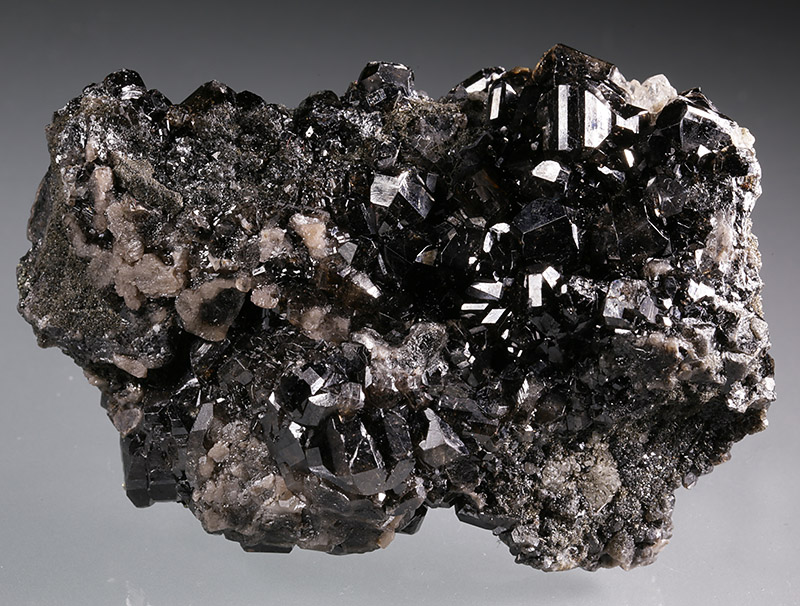
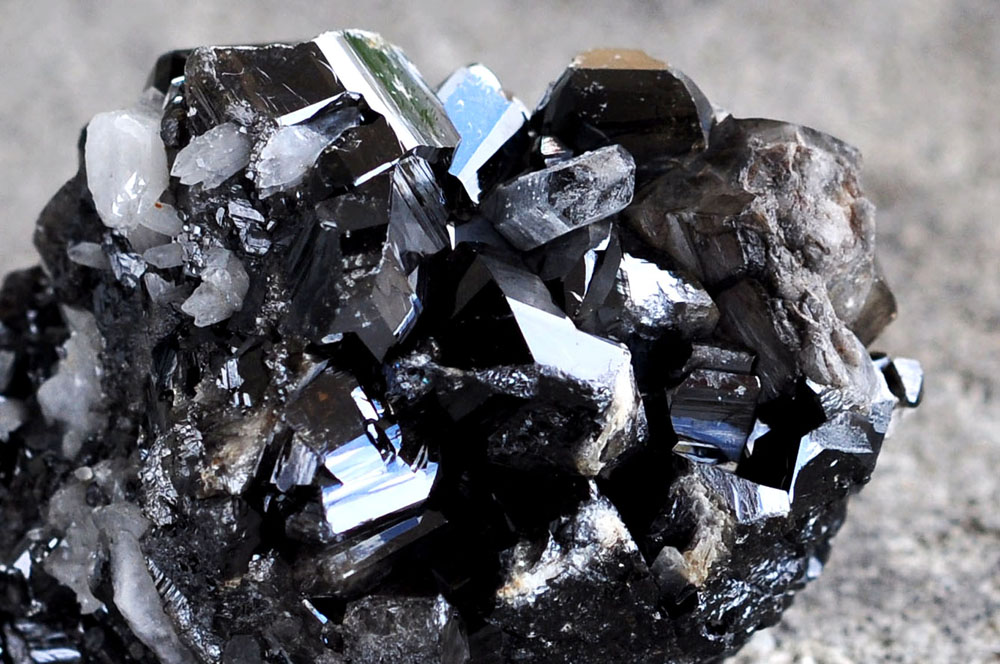

Cassiterite is the overwhelming source of the world's tin — a mineral of such consequence that the metal it yields named the Bronze Age. Few minerals have shaped human history so directly.
Dense and hard, cassiterite endures where softer minerals are ground away, collecting in river gravels over millennia. That toughness is the heart of its grounding, manifesting character.
Cassiterite famously grows as bent "visor" or "elbow" twins — paired crystals locked at an angle — a habit so distinctive it serves as the mineral's signature.
"When you surrender before Swami, Swami stands for you. When Swami stands for you, no one can stand against you."— Swami Samarth
Cassiterite is heavy, hard and enduring, and it brings that nature into the energetic body as grounding and power. Its frequency sits at the sacral centre — the seat of desire, emotion and creative flow, the watery, magnetic chamber of "creative juice" — and its Power of eight is its strongest trait: this is a forceful stone, transmitting its frequency with enough strength to break a stuck pattern loose and dissolve it.
Its named work is rejection — the old wounds of being turned away, refused, cast out, which lodge in the sacral and colour a person's whole sense of worth and desire. As a Healing stone, cassiterite stays on that wound rather than moving the energy elsewhere, dissolving it where it sits. And because it grounds, it does this from a place of stability and strength, settling the lower body so the work does not destabilise.
From that cleared, grounded base comes its other gift: the manifesting of destiny. Life and Joy ride with it — vitality fed into the sacral, and the clean gladness of an emotion finally released — and like the tin-stone that endures every weathering and settles, heavy and certain, into the riverbed, cassiterite helps a person find solid ground and build a destiny that lasts.
"We reap what we sow. Do your duty without worrying about the results; everything else will be handled by the cosmos."— Swami Samarth