
KNa4Ca4(CO3)4Si8O18(F,OH)·H2O
a deep blue eye-light that frees the voice almost as high as kyanite
Carletonite takes its name from Carleton University in Ottawa, Canada — the institution attended by the mineralogist who discovered and formally described it. The mineral was named in honour of the university as a lasting acknowledgement of the academic home that shaped its discoverer's work. The name carries no reference to colour, form, or locality; it is a straightforward institutional tribute, linking the stone permanently to the Canadian capital and to the tradition of scientific inquiry pursued there.
Carletonite belongs to the tetragonal system with space group P4/mbm, forming short prismatic to tabular crystals. Its chemistry is unusually composite: layered silicate sheets (Si8O18) are interleaved with carbonate groups (CO3)4 and charge-balanced by potassium, sodium, and calcium — an arrangement rare among silicates. This hybrid architecture produces perfect cleavage on {001} and good cleavage on {110}, giving freshly cleaved surfaces a vitreous lustre. The refractive indices are closely spaced (nω = 1.521, nε = 1.517), yielding very low birefringence and a uniaxial negative optical figure. Pleochroism is weak, shifting between pale blue and pale pinkish-brown, which means the blue colour is essentially stable regardless of viewing orientation. The mineral's relatively soft hardness of 4–4.5 reflects the loosely bonded mixed-anion framework.
Carletonite was first described in 1969 by geologist G. Y. Chao, who recovered specimens from the Poudrette quarry at Mont Saint-Hilaire, a syenite intrusion on the south shore of the St. Lawrence River in Québec, Canada. The Mont Saint-Hilaire complex is one of the most mineralogically productive localities on Earth — an alkaline igneous body that has yielded well over 60 mineral species found nowhere else. Carletonite is among the most prized of these, occurring in cavities and pegmatitic pockets within the nepheline syenite alongside natrolite, analcime, and aegirine.
Mont Saint-Hilaire remains the only confirmed source of carletonite in the world. No additional occurrences have been reported at any other locality. The Poudrette quarry, though primarily operated for aggregate, has allowed collectors and researchers periodic access, making carletonite specimens available but consistently rare on the mineral market.
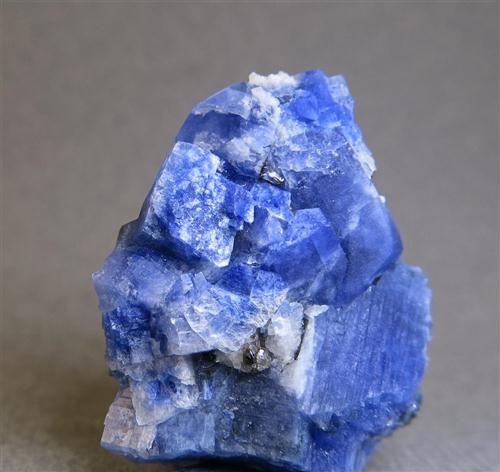
Carletonite's translucent blue ranges from pale sky to a deeper cornflower tone. Because its pleochroism is so weak, the colour reads as uniform from all angles — a quality that sets it apart from many coloured minerals that shift dramatically between orientations. This stable, pervasive blue, combined with a vitreous lustre on cleavage faces, makes well-formed specimens visually striking.
Known from one quarry in one mountain in Canada — and nowhere else on the planet. This degree of geographic confinement is extreme even by rare-mineral standards. The stone cannot be substituted or sourced elsewhere; its supply is permanently tied to the ongoing access granted at Mont Saint-Hilaire's Poudrette quarry.
The coexistence of silicate sheets and carbonate groups within a single tetragonal structure is an architectural rarity in mineralogy. Most minerals belong cleanly to one chemical class; carletonite bridges two, producing a hybrid framework that has fascinated crystallographers since its description in 1969.
"In pure being consciousness arises; in consciousness the world appears and disappears. Before all beginnings, after all endings — I am."— Nisargadatta Maharaj
There is a particular quality of seeing that does not merely observe — it dissolves. When the inner eye opens cleanly, whatever it rests on begins to soften, to loosen, to let go of its grip. Carletonite carries this dissolving quality. Its frequency sits at the level of the inner eye, working as a kind of quiet magnifying glass held steadily over whatever is held or stuck. You might sit with it and notice, after a time, that something you could not say — something lodged in the throat, unexpressed and half-forgotten — begins to feel lighter, as if the air around it has thinned.
This is not a stone of great force. It does not press or insist. The power here is more like the power of clarity: when you can truly see a thing, it loses the authority it held in the dark. What carletonite seems to do, in its gentle and medium-duration way, is bring the seeing down — from the eye into the throat — the way a lamp carried into a room reveals what was always there. The voice does not need to be pushed. It only needs the obstruction removed.
Carletonite sits close to kyanite in this work of freeing expression, reaching almost the same height on the frequency scale — a rare proximity. Both stones address the throat, but carletonite does so from above, from the perspective of the inner eye, which sees the fear or the contraction and, by seeing it fully, allows it to dissolve. The ancient teachers understood this: full attention held on anything, without flinching, without commentary, is itself the dissolving agent. Nothing can remain solid when looked at long enough with no judgement, nothing is what it seemed.
"Silence is truth. Silence is bliss. Silence is peace. And hence Silence is the Self."— Ramana Maharshi
What is quietly remarkable about this stone is the particular order it works in. First comes an inner quieting — a settling of the restless commentary — and out of that stillness, once it is real rather than forced, there arises a natural readiness to speak. Not to perform, not to impress, not to defend — simply to say what is true. All is well. Nothing is wrong with what you have to say. The only question, ever, is whether you can see clearly enough to say it. That is where carletonite does its work, in the interval between knowing and speaking, holding the eye open so the voice can follow.