

KPb26Ag9Cu24(OH)48Cl62
Blue cube of calm, emotion finding its level
Boleite takes its name from its type locality, the El Boleo mining district near Santa Rosália in Baja California Sur, Mexico, where it was first described in 1891. The Boleo copper district lent its name to a whole small family of related blue oxychloride minerals.
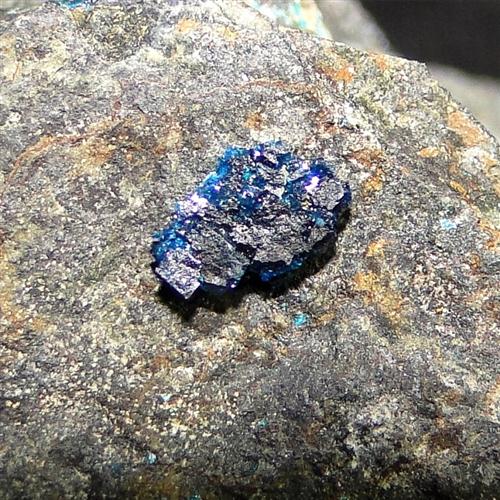
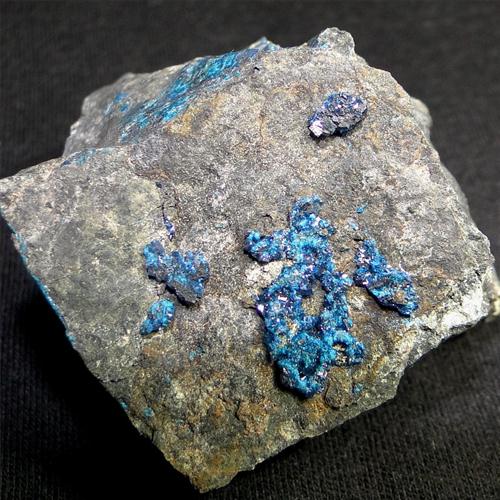
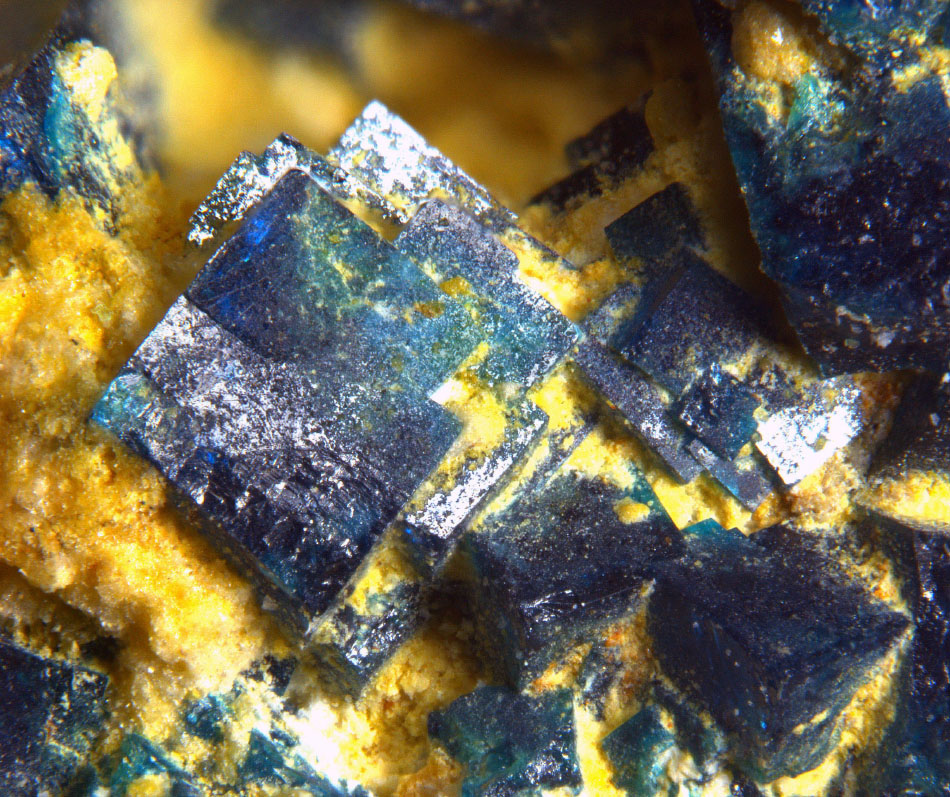
Boleite is a complex potassium-lead-silver-copper hydroxychloride that crystallises in the isometric system as striking deep Prussian-blue to indigo pseudocubes, often penetration-twinned and with perfect cubic cleavage. It is fairly soft, around 3–3.5 on the Mohs scale, with a vitreous-to-pearly lustre and a greenish-blue streak.
It belongs to a tight little family of rare Boleo oxychlorides — pseudoboleite, cumengite and diaboleite — which can grow in oriented intergrowths upon one another, building the layered, box-like crystals that collectors prize.
First described in 1891 from El Boleo, Santa Rosália, Mexico, boleite forms in the oxidised zones of lead-copper deposits, where chloride-rich solutions — often derived from seawater — react with primary sulfide ores.
It remains a great rarity, valued as a minor ore of lead, copper and silver but treasured far more for the perfection of its blue crystals.
Contains lead, copper and silver — do not ingest, lick, or make crystal water or elixirs from this mineral. Lead compounds are cumulative poisons that build up in the body over time.
Wash hands after handling. Do not grind or polish it dry or inhale its dust, and keep it away from children and pets.
A rare cubic halide of lead, silver and copper, famous for its near-perfect indigo pseudocubes with mirror-flat cleavage.
It anchors a small family — pseudoboleite, cumengite, diaboleite — whose members grow in oriented intergrowths, layering box within box.
It crystallises where chloride-rich, sea-fed waters meet oxidising lead-copper ores — a true child of water and stone.
"Spiritual practice is not about changing what is outside of you; it is about recognizing the unconditioned nature of what is inside. If you do not recognize your own mind, your rituals are like painting on water."— Khenchen Tsewang Rigdzin
Boleite settles at the solar plexus — the fire-centre of will and personal power, and the body's main place of storing energy like a battery. Its frequency is modest and its transmission gentle, but it stays for a very long time, which is exactly why the blurb speaks of calm and focus: this is a slow, lasting stone that quietly steadies the centre rather than charging it.
As a stone of Life it feeds that centre with a calm, watery vitality — the river of energy that lifts the drained, foggy lethargy of an overworked belly — and its long duration lets it hold that steadiness in place. Its old reputation as a stone of calm and focus through “water energy” sits naturally with a mineral born where the sea's own brine met the rock; emotions, like water, find their level when nothing keeps stirring them.
"Don't worry, be happy."— Meher Baba
And it is Expanding: the steadied energy does not knot in the gut but radiates gently outward from the centre, so a person feels a little larger and more at ease with their surroundings — balanced rather than braced. It is a quiet, level stone for the settling of feeling and the keeping of one clear focus.