

NaBePO4
At the crown the field opens outward — what was a boundary becomes the beginning of everywhere.
Beryllonite was named in 1888 by the American mineralogist James Dwight Dana — also the architect of the Dana Classification System of Minerals — in straightforward reference to its beryllium content. The name simply combines beryllium, the element, with the standard mineralogical suffix -ite.
The name traces a long chain of inheritance: beryllium itself was named after the mineral beryl, and beryl derives from the ancient Greek bēryllos — a sea-green gemstone prized since antiquity and mentioned in classical texts as early as Pliny the Elder. Beryllonite's name thus reaches all the way back through nineteenth-century chemistry to that ancient Greek word, connecting a rare modern mineral to one of the oldest recorded gemstone names in history.
Beryllonite is a sodium beryllium phosphate built on a corner-sharing framework of alternating BeO4 and PO4 tetrahedra, with sodium ions held in the channels between them — the same architectural logic that underlies the feldspars. The crystals are typically colourless to pale yellow or white, transparent, and prismatic to tabular, showing a vitreous lustre on the faces and a brighter, almost pearly sheen on the well-developed cleavage.
Its moderate hardness (5.5–6) and easy cleavage both reflect those loosely-bound sodium channels, which let the mineral part along one direction far more readily than its tightly-bonded beryllium relatives beryl and chrysoberyl. The monoclinic cell is so close to orthogonal (β barely departs from 90°) that early crystallographers mistook it for orthorhombic — a celebrated case of pseudosymmetry.
The type locality is Stoneham, Oxford County, Maine — a granitic pegmatite outcrop explored in the late nineteenth century that yielded the first recognised specimens. Oxford County's pegmatite belt, stretching through Stoneham, Newry, and Greenwood, remains one of the most productive beryllium-mineral districts in North America and continues to supply fine collector material today.
Beyond New England, beryllonite has been documented across six continents: in Norway and Finland, where Fennoscandian Shield pegmatites produce occasional specimens; across the Hindu Kush ranges of Pakistan and Afghanistan, notably around Paprok in Nuristan Province; and in scattered occurrences in Brazil, Namibia, and Madagascar. In all settings the mineral forms in the late-stage, phosphate-rich zones of granitic and alkalic pegmatites — environments where sodium, beryllium, and phosphate happen to concentrate together in precisely the right proportions for an otherwise improbable composition to crystallise.
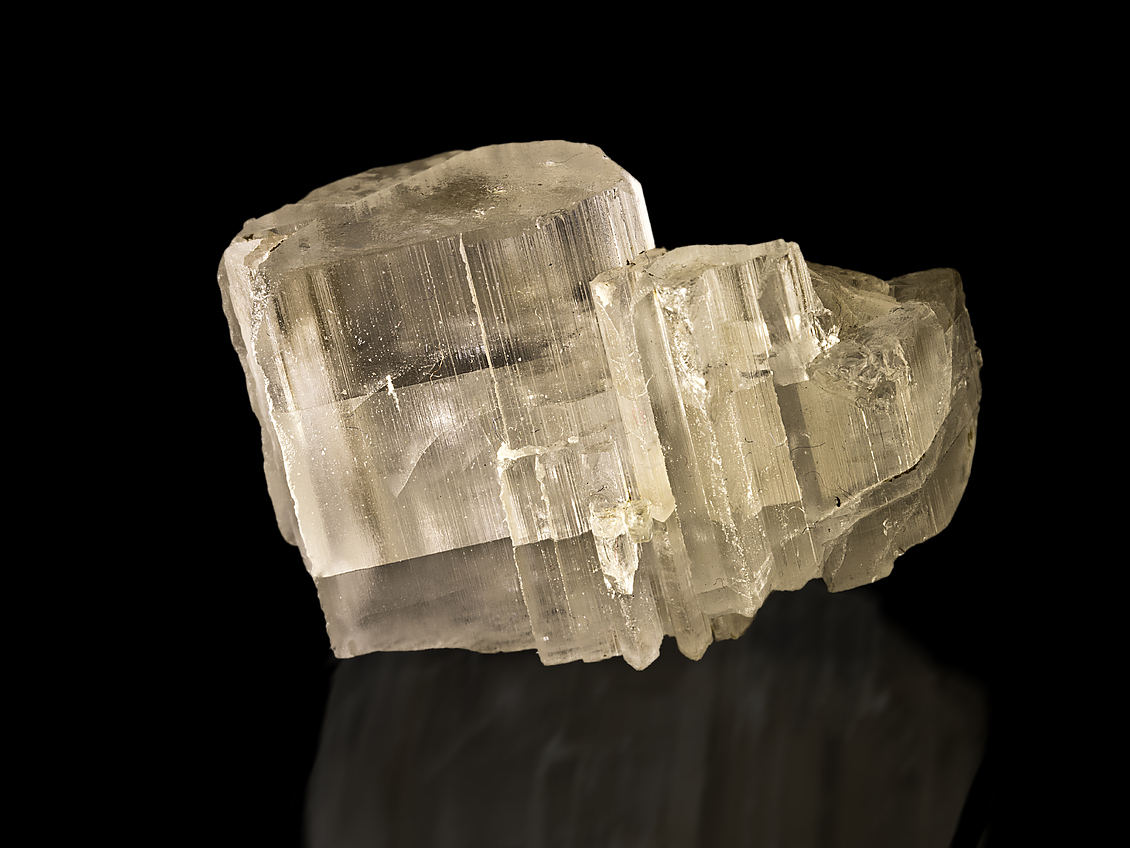
The {010} cleavage surfaces of beryllonite display a distinctly pearly to near-adamantine sheen — markedly brighter than the clean vitreous luster of the crystal faces. Within a single well-crystallised specimen both optical effects are visible simultaneously: glassy faces against gleaming, almost metallic cleavage planes. This duality of luster within one mineral is unusual among phosphates and gives fine beryllonite pieces an understated but striking optical quality.
Although beryllonite belongs to the monoclinic system, its β-angle deviates from 90° by less than a quarter of a degree — one of the smallest monoclinic departures from orthogonality known in mineralogy. Combined with systematic polysynthetic twinning, this near-perfect mimicry of orthorhombic geometry deceived early crystallographers and makes beryllonite one of the mineral kingdom's most convincing cases of pseudosymmetry: a crystal wearing a higher-symmetry mask.
In beryllonite's crystal structure, BeO4 and PO4 tetrahedra alternate in a corner-sharing three-dimensional framework — the same architectural logic as the feldspars, the most abundant mineral group in Earth's crust. Sodium (Na⁺) ions occupy the interstitial channels of this framework, completing a structural design that is both exceptionally stable and exceptionally rare: the beryllate-phosphate framework type is represented by only a handful of minerals worldwide.
"There is no me or I in the real world. There is only infinite consciousness."— Robert Adams
Beryllonite is among the more unusual high-frequency stones in that its energy begins at the crown and then moves outward rather than vertically. It does not drive the kundalini upward through the sushumna, and it does not ground downward into the earth. Its action is expansion — a widening of the field at the crown, as if the personal boundary of awareness is being quietly dissolved from the top. You are still present, still here — but the sense of being located in a small, bounded "somewhere" becomes less convincing, and then briefly unfindable.
The Expanding CrownThe crown chakra is the least "energetic" of the centres in any conventional sense. It does not fire or surge the way the solar plexus fires, or flood open the way the heart opens. It is better described as an aperture — the point where personal awareness thins back into what cannot be claimed by a person. Beryllonite works precisely here, and it widens this aperture not through pressure but through expansion. The effect radiates outward from the crown in all directions simultaneously, making you feel — genuinely, physically feel — larger than the body. The invisible perimeter of awareness, which most people carry without ever noticing it as a perimeter, begins to become porous and then, in better moments, simply not present in the usual way.
What practitioners consistently report is a softening of the felt sense of locatedness — the habitual conviction that experience is headquartered somewhere inside the skull. That locatedness, taken for granted as simply what it is to exist, begins to shift. The boundary between inside and outside becomes uncertain. The space within and the space without start to feel continuous. This is not hallucination or dissociation; it is the quiet recognition of what the Dzogchen tradition calls rigpa — not a special state to be achieved, but the natural condition of awareness prior to the contraction of self. The chakra map is, as Dzogchen would honestly acknowledge, provisional cartography: useful for pointing toward where experience shifts, not a literal architecture of stacked chambers. Beryllonite points firmly in the direction of that dissolution — toward the recognition that the sense of personal boundedness was always a kind of posture, and that awareness itself was never actually confined to the body looking out.
Frequency as a DissolverAt frequency 7 out of 10, beryllonite carries a vibration refined enough to work on the subtlest layers of contraction — not the heavy karmic residue that requires kundalini's sustained heat and years of purification to shift, but the barely-visible assumptions about who and where one fundamentally is. These assumptions are so close to the felt sense of self that they are rarely identified; they are too near, too familiar, too much like the background of everything. Robert Adams pointed directly at this — not with explanation but with a simple redirection: turn within, and look for the one who seems to be living behind the eyes. Look, and find nothing solid — only awareness, with no separate "me" at its centre. Beryllonite's frequency makes that looking slightly, but meaningfully, easier. It does not argue the self into non-existence; it simply makes the contracted reference point momentarily more transparent — fine enough to see through.
Its power rating of 6 means the effect is clear and reliable without being overwhelming. Its duration of 4 suggests it works most cleanly during active practice — meditation, self-inquiry, pranayama, or intentional stillness — rather than as a passive, all-day companion. This is not a limitation; it is an invitation. Bring beryllonite to your sitting. Let it do its quiet work on the upper field. Notice what becomes, even briefly, less solid in the usual architecture of self. That slight loosening — the momentary sense that the one who is meditating is perhaps not quite as real as habitually assumed — is exactly where inquiry becomes most alive, and most productive.
Light in the Dark PeriodsBeryllonite has a second, gentler office. Beyond inquiry, it brings light to dark or difficult times: when the upper centres feel clouded and life has narrowed to a hard grey corridor, it clears the upper chakras and lets the light back in, easing the way toward positive change. It does not force circumstances — it lifts the lid, so that the grace which was never actually absent can be felt again. This is the territory Vallalar sang of: the supreme Grace-Light that pervades all beings, in which the felt separateness between self and world is revealed as one luminous family — the very expansion beryllonite opens at the crown.
"God is the supreme Light that pervades all beings. All humans are one family, united by the light of grace."— Vallalar (Ramalinga Adigal)
For those working the upper registers of practice in particular, beryllonite is a faithful and surprisingly direct tool. Paired with a strong grounding stone at the root or earth star, its outward crown expansion is anchored and made coherent — spacious rather than unmoored, expansive rather than simply scattered.