
Ca2Ba4[(UO2)3O2(PO4)2]3·16H2O
The heart widening outward until what surrounds you feels like your own
Bergenite is named for the place where it was first found — the village of Bergen in the Vogtland district of Saxony, Germany — following the long mineralogical custom of naming a new species after its type locality. The mineral was first described in 1959; decades later, in 2003, its intricate crystal structure was solved and the species was formally redefined.
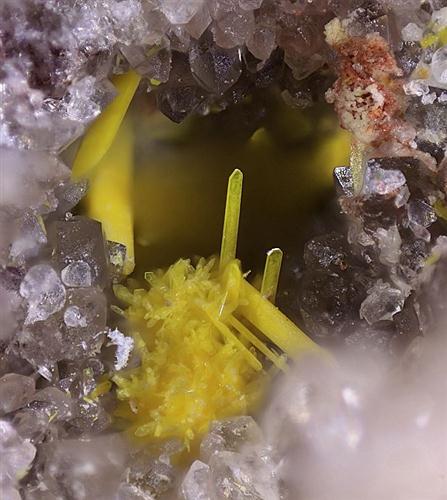
Bergenite is a secondary uranyl phosphate of the phosphuranylite group. Its structure is built from sheets of uranyl phosphate — uranium bonded into linear (UO2)2+ units linked with phosphate tetrahedra — between which calcium, barium, and abundant water molecules are held. As a soft, hydrous, monoclinic mineral it forms small yellow to greenish-yellow tabular crystals and crusts, and is almost always seen mounted on its host rock.
Bergenite's type locality lies in the Vogtland district of Saxony, Germany — the same historic Erzgebirge ("Ore Mountains") uranium province that fed the large-scale SDAG Wismut mining operations of the twentieth century. It forms as a rare secondary mineral in the oxidised zone of uranium deposits, crystallizing where uraninite (pitchblende) weathers in the presence of phosphate- and barium-bearing groundwater.
Like most members of the phosphuranylite group, bergenite is a genuine rarity — known from only a handful of uranium localities and prized by collectors of secondary uranium minerals rather than ever appearing in quantity.
Like most uranyl minerals, bergenite fluoresces a vivid green-yellow under ultraviolet light. The glow comes from the luminescence of the uranyl ion, (UO2)2+, and is bright enough that a UV lamp is a practical tool for spotting the mineral in the field.
Its yellow to greenish-yellow colour is the visible signature of that same uranyl ion — the linear O=U=O group is responsible for both the body colour and the fluorescence, so the two properties are really two faces of a single cause running through the structure.
"To truly surrender is not only to be beaten but to not care."— Swami Rudrananda
Bergenite is centred in the heart, and its movement is outward. It is an expanding stone: the warmth gathered at the heart does not climb toward the head or sink toward the belly — it radiates outward, pushing the heart's field past the edges of the body until the space around you feels included in it. Sitting with it, the chest seems less like a closed room and more like an open window, and the sense of "me, in here" softens into a feeling of being larger, more at one with whatever surrounds you.
The Heart That Radiates OutwardThe expansion moves through the layered bodies of the energy field, one after another, carrying the heart's warmth further out with each. Its strength is gentle rather than forceful, so this is not a dramatic opening but a slow, steady widening — and it asks for a kind of surrender, a willingness to stop guarding the heart and let it pour. What had been held in is allowed to extend, and the more freely it is given, the further the field reaches.
"Basic goodness is good because it is unconditional or fundamental. It is there already, in the same way that heaven and earth are there already."— Chogyam Trungpa Rinpoche
Bergenite is also genuinely rare — a scarce uranium mineral most collectors will never hold — and that rarity is part of its gift. Stones this hard to obtain work on abundance and havingness: the capacity to receive, to let good things in and keep them without flinching. To be drawn to something so uncommon and able to bring it close both reflects and strengthens that capacity, feeding a quiet loop that makes it easier to draw what you seek toward you. Because its power is soft and its working brief, it suits short, focused sessions rather than constant wear — and, being radioactive, it is best kept at a respectful distance, met for a while and then set back in its place.