
KCa4(Si8O20)F·8H2O
The crystalline silence in which the inner eye learns to see
The name derives from the Greek apo (ἀπό, "away from") and phyllon (φύλλον, "leaf"), describing the mineral's striking tendency to exfoliate — to split into thin leaf-like sheets along its perfect basal cleavage when heated. The leaves of a book peeling apart under heat was the visual the name captured. It was coined by the French crystallographer and mineralogist René Just Haüy in 1806, who formally characterized the mineral and established its distinguishing properties. Haüy's name has remained unchanged through the modern era, even as the original "Apophyllite" was reclassified into three distinct species sharing the same group name.
Apophyllite is a group of three closely related species — Fluorapophyllite-(K) (by far the most common, formula above), Fluorapophyllite-(Na) (sodium analog), and Hydroxyapophyllite-(K) (hydroxyl-dominant) — distinguished by their dominant monovalent cation (K vs Na) and dominant anion (F vs OH). Nearly all specimens in collections are Fluorapophyllite-(K); the other two species are considerably rarer and seldom identified outside specialist collections.
Despite belonging to the phyllosilicate (sheet silicate) class, Apophyllite presents as well-formed tetragonal prisms and square pyramids rather than the flat plates typical of sheet silicates. Its silicate sheets are structurally internal, expressed externally only through the perfect basal cleavage that gave the mineral its name. Eight water molecules per formula unit are locked into the lattice — integral to the structure, not surface moisture — and it is their release under heat that drives the characteristic exfoliation.
Characterized as a distinct mineral group by René Just Haüy in 1806. Specimens had been known to European collectors earlier — notably from the silver mines of Kongsberg, Norway — but Haüy's systematic analysis established its defining properties and introduced the name that has stood ever since.
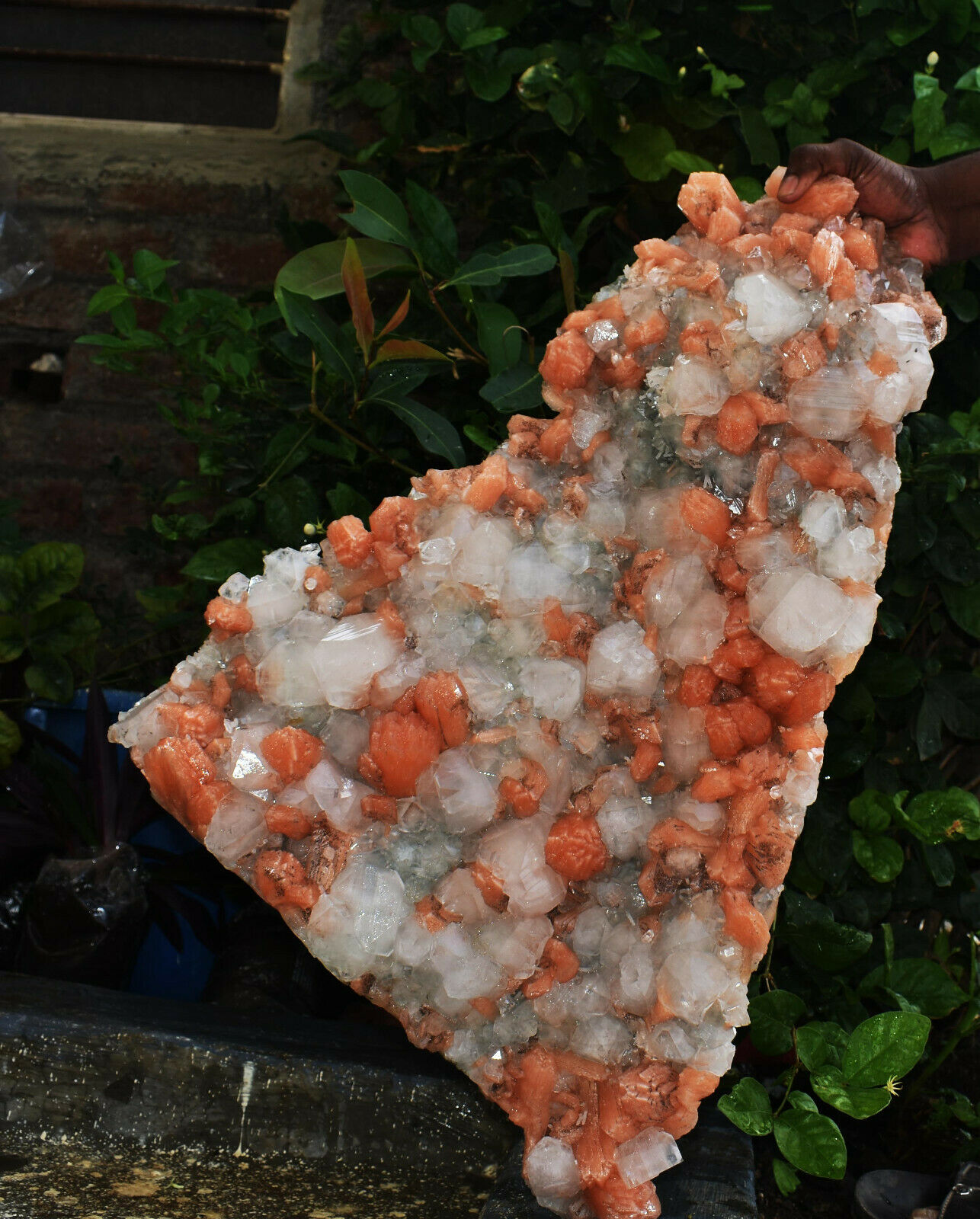
Today the Deccan Traps of Maharashtra, India — particularly around Pune (Poona) and Nashik — supply the overwhelming majority of all museum-quality and collector-grade specimens worldwide. These vast flood basalts, one of the largest volcanic provinces in geological history, produced enormous gas cavities in cooling lava that were gradually filled by silica-rich hydrothermal fluids. The result: crystal pockets yielding clear to pale green prisms and pyramids sometimes exceeding 20 cm, frequently growing on matrices of Stilbite, Heulandite, and other zeolites in spectacular natural compositions. Other significant localities include Guanajuato (Mexico), the Faeroe Islands, New Jersey (USA), Scotland, Iceland, Germany, and Brazil.
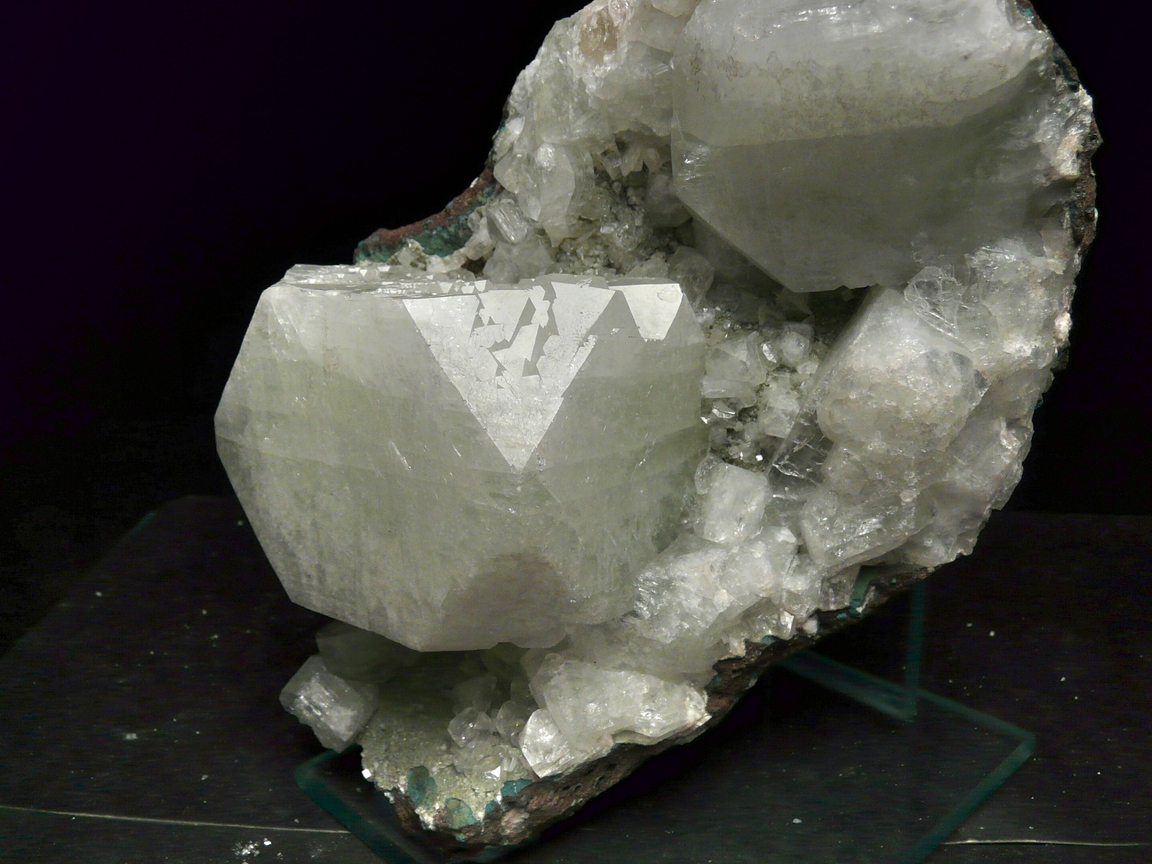
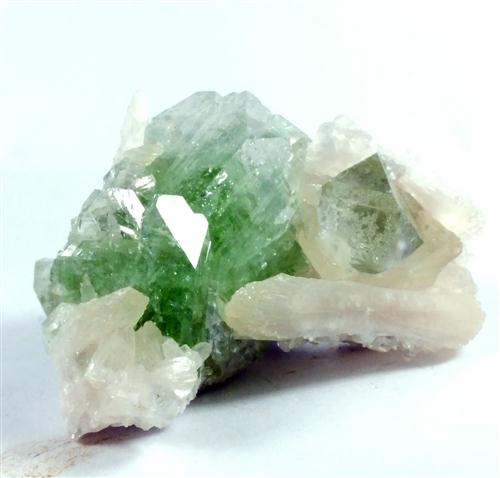
Apophyllite displays two distinct lusters on the same specimen: vitreous to sub-adamantine (glassy to near-diamond) on the prism and pyramid faces, and pearlescent to nacreous on the perfectly smooth basal cleavage surfaces. This combination — high brilliance on the crystal faces alongside a soft inner glow on the cleavage planes — is unusual in a single mineral and gives Apophyllite a visual depth that photographs rarely capture fully.
The {001} basal cleavage in Apophyllite is among the most perfect in the silicate group — a consequence of the layered sheet-silicate architecture running parallel to the base of the tetragonal prism. This cleavage yields glass-smooth surfaces that reflect light with a mirror-like perfection, expressing the mineral's sheet-silicate nature in a visually immediate way that is otherwise hidden by its prismatic outward form.
Apophyllite shows measurable double refraction (birefringence), splitting light into two rays as it passes through the crystal. In clear specimens of sufficient thickness, this can be observed as the doubling of a line or image viewed through the basal plane — an optical property that underscores the anisotropic layered structure beneath the apparently simple external form.
Apophyllite is a healing crystal centered at the Third Eye. Its action is not forceful, not moving outward or upward — it stays at the inner eye, working with the patience and precision of a mineral that takes millions of years to form. What it dissolves, slowly and consistently, are the layers that make the Third Eye opaque: habitual thought-patterns, the emotional residue of experience, the subtle distortions through which ordinary perception filters what is actually present. What the Third Eye sees when those layers thin is not something added, but something uncovered — a clarity that was always there, waiting behind the cloudiness.
The Still PointRamana Maharshi's inquiry ends not in an answer but in a silence — the I-thought traced back to its source dissolves, and what remains is the Self: ever-present, never achieved, requiring nothing to be done. Apophyllite creates favorable conditions for this kind of stillness specifically at the Third Eye. Its healing energy dissolves at the ajna rather than moving through it, quieting the inner chatter that obscures the eye's natural capacity. At frequency 6, it works on the moderately deep layers — habitual perceptual overlays accumulated through ordinary experience. The result is a quality of restful inner alertness: the eye open, the mind still, nothing to seek or fix.
Gnananda Giri, whose entire teaching was the economy of stillness, operated in the same register as the crystal itself: pointing at what cannot be added, only uncovered. Apophyllite does the same — and Ramana Maharshi, whose inquiry and Gnananda's silence converge at the same recognition, named that destination precisely.
"Silence is truth. Silence is bliss. Silence is peace. And hence Silence is the Self."— Ramana Maharshi
The Third Eye's natural function is not to see visions or gather information — it is discrimination itself: the capacity to perceive what is actually present without the distortion of projection, conditioning, or desire. Nisargadatta Maharaj cut to the structure of the problem directly: "The world appears in you, not you in the world." Apophyllite's healing frequency steadily clears the distortion field at the inner eye. What begins as a sense of spaciousness at the forehead deepens gradually into a quality of seeing that is not directed at anything in particular — open, self-luminous, content-free attention resting in itself.
With duration D=5, this quality continues for several hours after contact — sufficient to carry the inner clarity through a full meditation session and into the quieter part of the day that follows. Power P=6 is consistent, significant without being intense, well-suited to daily and ongoing use. The crystal asks nothing dramatic. It simply holds the space until the eye adjusts.
"The world appears in you, not you in the world."— Nisargadatta Maharaj