

K2Na2(Si4Al4O16)·5H2O
The veil of duality dissolves as consciousness opens into the galactic field
Amicite was named in honor of Giovanni Battista Amici (1786–1863), the Italian physicist, astronomer, and optical instrument maker renowned for inventing the Amici prism — a right-angle dispersing prism fundamental to modern spectroscopes and telescopes. The name was formally bestowed in 1979 by mineralogists C. D. Alberti, F. Vezzalini, and S. Quartieri when they published the first complete description of the mineral. The suffix -ite follows the standard mineralogical convention of naming species after distinguished scientists.
Amicite belongs to the zeolite group — a family of aluminosilicate minerals characterised by an open three-dimensional framework of SiO₄ and AlO₄ tetrahedra linked at all corners. This cage-like structure creates internal channels and cavities occupied by water molecules and exchangeable cations (K⁺ and Na⁺ in amicite's case). The crystal habit is pseudotetragonal bipyramidal — the near-equality of the a and b unit cell parameters causes monoclinic crystals to display apparent tetragonal symmetry, which can deceive identification in the field.
First described in 1979 from the Höwenegg quarry in the Hegau volcanic region of Baden-Württemberg, Germany — a locality known for its rich assemblage of zeolite minerals in basaltic lavas. The mineral was subsequently identified in natrolite veins cutting ijolite-urtite pegmatites and apatite-nepheline rocks at the Kirovskii apatite mine on Kukisvumchorr Mountain in the Khibiny Massif, Kola Peninsula, Russia — one of the world's largest alkaline igneous complexes. Amicite remains a rare mineral, typically found in small quantities in zeolite-bearing alkaline igneous rocks and related pegmatitic environments.
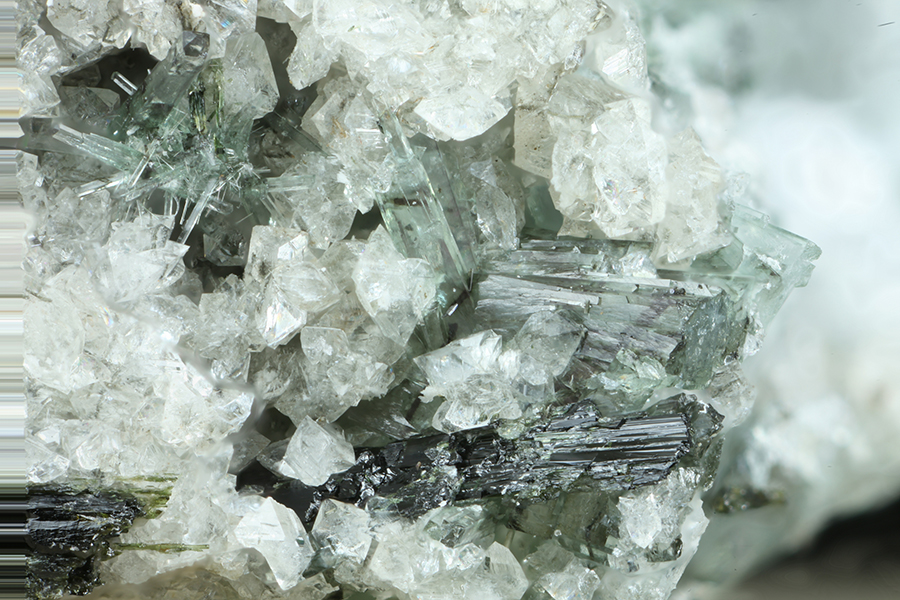
Although amicite crystallises in the monoclinic system, its crystals routinely exhibit pseudo-tetragonal bipyramidal forms because the a and b cell parameters are almost equal. This creates an appearance of higher symmetry and is a known source of misidentification in the field — a reminder that outward form can conceal a deeper, more complex inner architecture.
Amicite's open zeolite framework allows its K⁺ and Na⁺ cations to be replaced by other ions without destroying the crystal lattice. This reversible cation exchange is one of the most functionally remarkable properties in the mineral kingdom — and it operates at room temperature, without energy input beyond the exchange medium itself.
"God is the supreme Light that pervades all beings. All humans are one family, united by the light of grace."— Vallalar
Amicite is a rare and precious gem among the high-frequency minerals — one of only a handful known to vibrate higher than phenacite, working entirely above the crown in the Galactic field, where individual consciousness begins to dissolve into something vastly larger. Its vibration runs so high that some who readily feel other crystals cannot reach it yet; like penfieldite, amicite simply blows the whole energetic system open. Where most stones still labour within the seven bodily chakras, amicite reaches beyond all of them, into the Grace-Light itself.
The Galactic GateAt the very top of the frequency scale it does not merely stimulate or clear — it draws awareness through ever finer layers of identification until the ordinary sense of "me" grows transparent. Its kundalini carries the upward force of this passage: this is no gentle stone. The primal energy wakes and threads up the sushumna, burning the old karma as it climbs, gathering momentum through each centre until it rises into the galactic field above the crown. And because it never needs energetic cleansing, it keeps that pure frequency intact.
"Within complexity I discovered dharmakaya; within thought I discovered nonthought."— Tulku Urgyen Rinpoche
Amicite is a Universal Chakra opener and activator. It shows you the way into the light, and following that light it unlocks the mind's identifications — the very knots that split a seamless reality into "this" and "that" — and lets a non-dual reality stand clear. In the expanded chakra map above the crown — the Soul Star, the Universal, the Galactic, the Divine Gateway — amicite's work takes place in these upper fields, dissolving the subtlest residual identifications that cling even to advanced practitioners. A single medium specimen is fully sufficient; a larger stone deepens the work without changing its nature.